
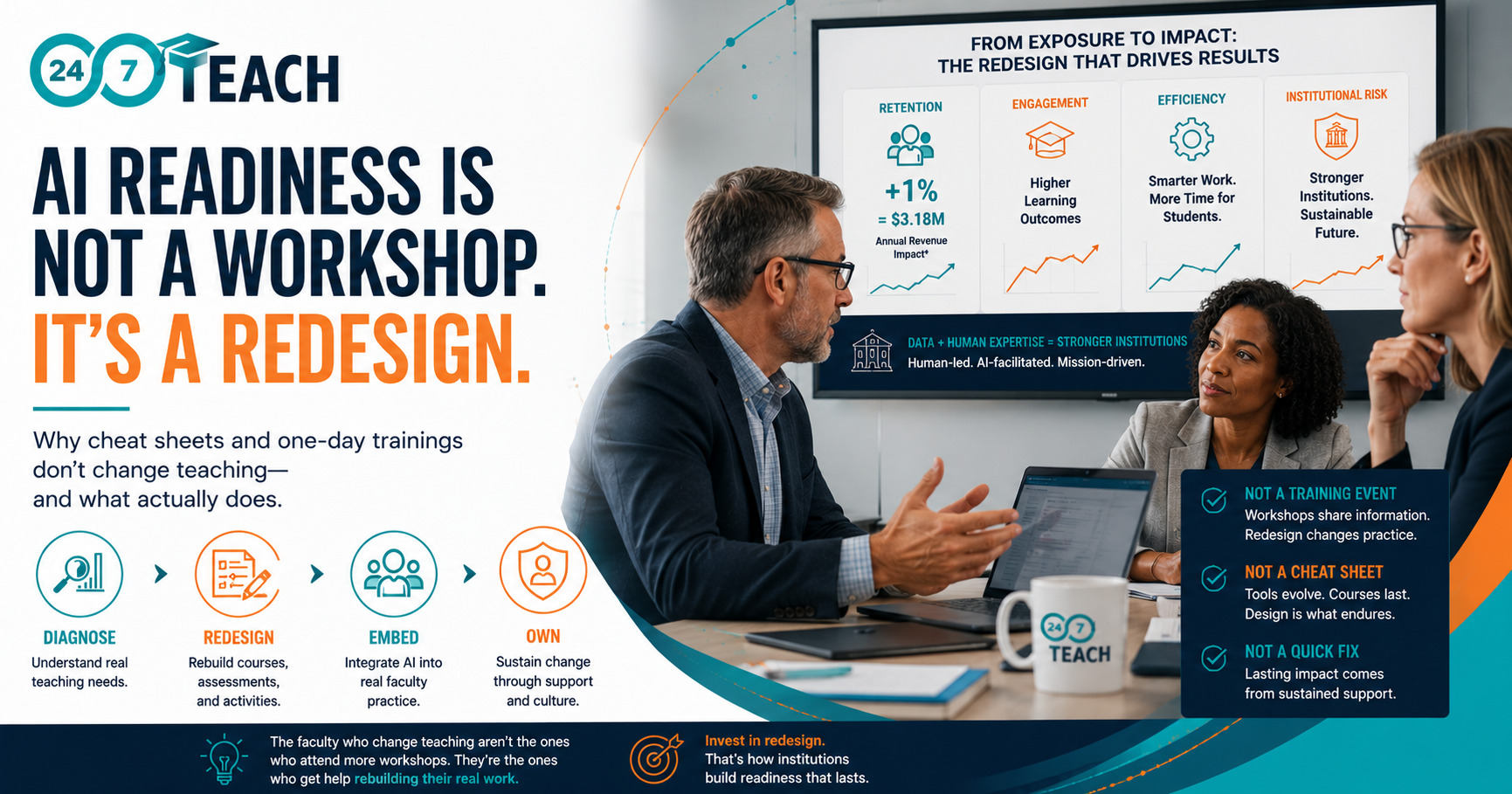
Two faculty members at the same institution can attend the same AI workshop, download the same guide, and walk away with completely different approaches to teaching. One starts redesigning her assignments the next week. The other files the handouts and changes nothing. The difference between them is not what they were taught. It is whether anyone helped them rebuild the actual work of their courses.
I made a version of this argument recently about policy. A downloadable template makes an institution compliant, not governed. The same trap is quietly draining AI training budgets and making a necessary process ineffective. A workshop is an event. Readiness is a rebuild. The two cost different things and produce different results, and most institutions are paying for the first while believing they bought the second.
This is the part of faculty AI readiness most institutions are getting wrong, and it is costing them real money. The dominant model treats readiness as a knowledge-transfer problem: pick the tools, buy the course licenses, run the workshop, distribute the guide. That model is comfortable because it is measurable. You can count attendance. What it cannot do is change how a single course is taught. If you lead AI adoption at your institution, a provost, an academic affairs or faculty-development head, or a center-for-teaching director deciding where this year's AI budget goes, the most important thing to understand is that you are not funding a training initiative. You are funding a redesign initiative, and the two require different work. This piece gives you the framework to fund the right one. Diagnose, Redesign, Embed, Own.
The data says exposure does not transfer
Start with the finding that should reframe the entire conversation. In the Tyton Partners and D2L Time for Class 2025 report, which surveyed more than 3,300 students, instructors, and administrators across over 900 US colleges, researchers looked at which instructors actually changed their teaching once generative AI arrived. Among instructors who do not ban the tools, 46% of those who use AI daily now actively encourage their students to use it. Among those who tried the tools only once or twice, that figure was 3%.
Sit with that gap. The faculty who touched AI briefly, the exact group a one-day workshop or a downloadable cheat sheet produces, did not meaningfully change their classrooms. The faculty who use it daily, embedded in their real work, did. Exposure is not the input that drives practice change. Sustained, situated use is.
The rest of the readiness data tells the same story from a different angle. The Digital Education Council's 2025 Global AI Faculty Survey found that 61% of faculty have used AI in teaching, but 88% of them do so minimally. IREX and Development Gateway, in their 2026 global readiness report with the UN Sustainable Development Solutions Network, found that only 37% of respondents had received any ongoing AI training, and that fewer than one in five institutions had governance structures to manage AI responsibly. The picture is not a faculty that has never heard of ChatGPT. It is a faculty that has been exposed and has not been moved.
The cheat sheet is not wrong; it is just aimed at the wrong target
Be fair to the cheat-sheet approach for a moment, because it is not useless. A good tool guide lowers the activation energy. It tells an anxious associate professor that Claude, ChatGPT, and Gemini exist, what each is roughly good at, and that the world will not end if they try one. That is a real on-ramp, and dismissing it would be a mistake.
The problem is what comes after the on-ramp, which is usually nothing. The workshop ends. The handout names tools that will be three versions out of date by next fall. And critically, the faculty member returns to a syllabus, a set of assignments, and an assessment scheme that were all designed for a world where students could not generate a competent essay in nine seconds. The training touched none of that. It taught the tool and left the course untouched.
This is why so much AI professional development feels like motion without progress. UPCEA and EducationDynamics found in 2025 that 44% of institutions still lack any plan to upskill or support staff on AI, and that the top two barriers leaders named were staff readiness and resistance to change. Notice that neither barrier is a tools barrier. They are change-management barriers, and you cannot solve a change-management problem with a slide deck.
*Note: This article was researched and written by Justice Jones with AI assistance, then reviewed and edited by our team. External studies and sources are credited to their original authors. Examples from our own work reflect our organizational practice.*
What AI actually broke was the assessment
Here is the reframe that makes the redesign argument concrete. The thing generative AI disrupted most in higher education was not faculty productivity. It was the assessment of learning.
For decades, the take-home essay, the problem set, the discussion post, and the lab write-up worked as proxies. A student who produced a good one had probably done the thinking. That inference is now broken. The artifact a student submits no longer reliably tells you what the student can do without the machine. Ethan Mollick of Wharton put the stakes plainly when he wrote that standard lecturing and conventional assignments would become untenable and require substantial revision. He was not predicting a tooling inconvenience. He was describing the collapse of a measurement system.
This does not hit every course equally, and it is worth being precise about who feels it most. The faculty whose assessment AI actually broke are the ones who taught and graded through the written take-home artifact: first-year composition, the humanities, the social sciences, and the writing-heavy parts of business and law. Courses already assessed through proctored exams, labs with shown work, or studio and clinical demonstration were disrupted far less, because their measurement was never a take-home proxy in the first place. A redesign program should follow that line, not treat all faculty as one undifferentiated group.
EDUCAUSE's 2026 report on AI and learning assessment, based on a survey of faculty and staff, found exactly this pressure point: growing momentum to use AI in assessment alongside real uncertainty about how, with reporting that fewer than 30% of faculty feel confident designing assessments that hold up in an AI world. That is not a tool-knowledge gap. It is an assessment-design gap, and no workshop on prompt writing closes it.
The downstream effects are already in the data. Academic-integrity cases tied to AI have surged across institutions, and faculty report that policing suspected misuse has become its own time sink. The same Tyton report that found daily users saving time also found that instructors trying to monitor improper AI use experienced increased workload. So the institution that responds to AI by training faculty on tools, without touching assessment, manages to import the disruption and skip the fix. It teaches people to drive the thing that broke the road, and does no road repair.
The work that actually addresses this is redesign: rebuilding assignments so that the cognitive demand sits where AI cannot quietly stand in, making AI use an explicit and assessed part of the task where appropriate, and shifting some weight back toward in-class reasoning, oral defense, drafting, and process. Marc Watkins, writing in The Chronicle of Higher Education, framed the most durable move as making AI part of the assignment rather than a contaminant to be detected. None of that is tool training. All of it is instructional design.
How can AI fix what it broke
There is an obvious objection here, and it deserves a direct answer. If AI is what broke assessment, how can it be part of the repair?
The objection hides an assumption worth naming. AI did not break the course. It broke one inference the course quietly depended on. For decades, a good essay was treated as proof that the student did the thinking, because producing a good essay used to require the thinking. That was always a proxy, not a measurement. AI severed the link between the artifact and the effort. So the honest version of "AI broke the course" is that AI exposed your measurement as a stand-in and removed the friction that kept the stand-in honest.
Once you see that, the paradox dissolves. AI does not fix the course. The faculty member does. AI no more repairs a curriculum than a calculator repairs a math program. The human redesigns, and the tool is used in that work. That is the whole meaning of human-led and AI-facilitated.
The human work is the redesign itself: moving weight off the final artifact and onto things you can observe, such as in-class writing, staged drafts with check-ins, oral defense, and a visible process, then raising the cognitive demand to where the value lives in the student's own context. That is pedagogical judgment, and only the human has it.
AI then shows up in three specific places. First, as the redesign collaborator. A professor hands the model an old assignment and its learning outcomes, instructs it to cheat, and watches it expose the hole faster than the professor could alone, then has it draft variants and a first-pass rubric. Faculty Focus has documented instructors stress-testing assignments with AI exactly this way, and it collapses the time cost that is the top objection to redesign. Second, as a deliberate element inside the new course, used openly as a tutor, a sparring partner, or a flawed draft the student has to critique, so the assessment measures the judgment a student applies to the machine rather than raw production. Third, as the new thing worth assessing: whether a student can evaluate AI output, catch a hallucination, and know when not to use it, a skill the old essay never measured.
The part most institutions miss is that much of the fix is deciding where AI does not belong. The unplugged draft. The oral exam. The in-class hour. A machine cannot make that call. A person who understands the discipline can. Using AI to fix a course often means using AI to help a professor decide where to keep AI out.
One honest limit. A skeptical reader will ask whether this is an arms race, where today's AI-proof assignment is next year's solved one. Partly yes, if the redesign chases clever prompts the current model cannot handle, because that edge decays. What does not decay is the human-observable work: live reasoning, defense under questioning, application to a student's own context, and judgment about the machine itself. The durable redesign targets those, precisely because they were never proxies to begin with.
Faculty are not learners here, they are builders
There is a subtle but expensive assumption baked into the workshop model: that faculty are the students. That they need to be taught the material and then tested on whether they absorbed it. For AI readiness, this is the wrong relationship.
Mollick and his colleague Lilach Mollick argue in their work on instructors as innovators that the highest-value move is to put faculty in the role of builders, using their own disciplinary and pedagogical expertise to design AI-integrated exercises that no central office could write for them. A chemistry professor knows which AI use will help a student learn stoichiometry and which will let them skip it. A composition instructor knows where a model's fluent prose will short-circuit a developing writer. That judgment is the asset. As Mollick puts it, the focus needs to move from task automation to capability augmentation, and the faculty member is the one who decides what to augment.
Catherine Shaw of Tyton Partners points at the same gap from the institutional side. Her read of the survey data is that most faculty hold an instrumental rather than strategic view of their digital tools, seeing the learning platform as a place to post grades rather than as an instrument of student success. The institutions that get readiness right are the ones that change that mindset, and a mindset does not change in ninety minutes. It changes through sustained, supported practice inside the faculty member's own course, with someone alongside them who knows both the pedagogy and the technology.
The DREO framework: what readiness actually requires
If readiness is a redesign problem, the program looks nothing like a workshop series. It looks like an operating sequence. Four steps separate a readiness model that works from an exposure model that does not. Diagnose, Redesign, Embed, Own. DREO is the teaching-side sibling of the Govern, Map, Measure, Manage framework I use for AI governance: same idea, that the real work is an operating system, not an event.
Diagnose. Before buying any training, find the courses where AI actually broke assessment. Look for the integrity spikes, the faculty who quietly stopped trusting their own assignments, and the writing-and-analysis gateway courses that carry the most enrollment. This is your redesign priority list, and it is more useful than any tool survey. You cannot fix what you have not located, and a campus-wide workshop is what institutions buy precisely because they skipped this step.
Redesign. Rebuild those specific assignments with the faculty who teach them, in their discipline, with their learning outcomes intact. This is co-design, not a generic module handed down from a central office. Faculty bring an assignment AI broke, and the work is rebuilding that one, targeting assessment and judgment rather than a menu of tools. The deliverable is not a professor who can name five AI products. It is a course where the assessment is sound again and the instructor can say why a given task is or is not a place for the machine. This is the model 24/7 Teach uses in its organizational engagements. Across more than 50 organizations we have supported, the engagements that stick are the ones where the institution's own people did the building, with us, on their real material.
Embed. Run the redesign across a term, not a day. The Time for Class data is unambiguous that practice change comes from frequent, situated use, not a single sitting. Faculty implement the redesigned assignment, watch what actually happens in their classroom, and iterate. This is the step the workshop model structurally cannot deliver, because the workshop ends and the course was never touched.
Own. Hand off so the institution can run this work itself after the engagement ends. The goal is institutional capability, not a permanent dependency on an outside vendor. The Human Led, AI Facilitated principle applies as much to faculty development as to the classroom: the people who run the institution should own the capability when the consultant leaves. An AI readiness program that cannot hand off has not produced readiness. It has produced a retainer.
Where to start if you lead AI adoption
DREO is the framework. Starting it does not require a campus-wide mandate, and it should not begin with one. The strongest objection to redesign is practical, and it deserves a straight answer: redesign costs more than a workshop, it needs faculty time, and much of the teaching at many institutions is done by adjuncts paid only to teach, with no release time to rebuild a course. Telling an overstretched faculty to reinvent their assessment schemes reads as one more unfunded mandate. There is also a fair point in the data, that faculty who use AI daily report reduced workload, so baseline tool fluency is not worthless. The resolution is sequence, not exclusion. Fluency is the on-ramp. Redesign is the destination. An institution that funds only the on-ramp has bought the most expensive form of standing still.
So start small and funded. Run DREO on two or three high-enrollment gateway courses where AI most obviously broke assessment, fund the faculty time to redesign them properly, and treat those courses as the proof and the template for everything that follows. Then measure the right thing. Attendance at a workshop is not a readiness metric. Redesigned courses are. Track how many courses changed their assessment design, how many faculty moved from occasional to regular use, and what happened to integrity cases in the redesigned sections.
And do it alongside governance, not after it. With fewer than one in five institutions holding real AI governance structures, the policy and the pedagogy have to advance together. A redesigned course inside a policy vacuum is fragile, and a policy with no redesigned courses underneath it is a document that changed nothing. Govern, Map, Measure, Manage on the policy side. Diagnose, Redesign, Embed, Own on the teaching side. Same institution, two operating systems, one readiness.
The institutions that will look prepared in two years are not the ones that ran the most workshops or distributed the best guide. They are the ones that treated faculty AI readiness as what it actually is, the course-level work of rebuilding how teaching and assessment function when every student has a capable machine in their pocket. That work is human-led. The tools only facilitate it.
About the author
Justice Jones is a Learning & Development Leader, Director of AI Integration, former K-12 principal, and the founder and Chief AI and Strategy Officer of 24/7 Teach. He built the company to close the gap between what schools teach and what teens and professionals need to succeed, and he leads AI strategy at its sister company, Naomi-AI, a K-8 classroom platform. Through 24/7 Teach, he and his team have supported more than 50 organizations and placed more than 600 adults in new careers.