Most organizations have paid for training that changed nothing. The slides got built, the sessions ran, the completion dashboard turned green, and three months later, people worked exactly the way they did before. The money was spent, the box was checked, and the behavior held still. If that sounds familiar, the problem is almost never the topic. It is the way the training was produced.
The clearest way to understand that is through Henry Ford. Ford is remembered for the car, but his real invention was the way to build it. Before the moving assembly line, an automobile was a luxury good assembled one at a time, which is why almost no ordinary person owned one. The line cut costs enough that Ford's own workers could afford the thing they built. The product everyone remembers came from a process almost nobody talks about. The breakthrough was never the car. It was the production.
Training has the same shape. What works is well understood. What is missing is a way to produce it.
The kind of training that works is the hardest to make
The training that changes behavior is experiential. People learn by doing, by building, by being put in front of a real task, not by watching a deck. This is one of the most settled findings in education research. A 2014 University of Washington meta-analysis led by Scott Freeman pooled 225 studies and found that learners in passive, lecture-style formats were about one and a half times more likely to fail than learners in active, hands-on ones, with meaningful gains in performance across the board. Doing beats watching. That is not a matter of taste.
The catch is that experiential training is also the hardest and most expensive thing to produce. Anyone can stand up a library of videos and a quiz. Building a real experience, with an authentic task, the right scaffolding, an assessment that proves someone can actually do the work, and feedback that moves them forward, is slow and genuinely difficult. So most vendors and most internal teams quietly default to passive content, because it is what they can produce on a deadline, even though everyone involved knows it works worse. The effective thing is the hard thing to make, so the market fills up with the easy thing instead. That is the real reason your last rollout did not stick.
Where most training builds go wrong
If you have ever commissioned custom training, you have probably lived through the default model without knowing its name. The dominant approach in instructional design is ADDIE: Analysis, Design, Development, Implementation, Evaluation. It was built for the military decades ago, and it is a waterfall. Each phase finishes before the next begins, evaluation sits at the very end, and you frequently do not discover that something does not land until it has already been fully built and delivered. By then, it is expensive to fix, so it usually does not get fixed.
The field saw this problem. In 2012, Michael Allen introduced the Successive Approximation Model, an agile, prototype-first alternative built on the idea of small, fast iterations rather than a single long march. That was the right instinct, and it is the lineage we build on. But iteration alone does not guarantee a result. You can prototype forever and still ship something nobody uses. Something has to make each step prove itself. For us, that something is the demo.
PDDD, and why your engagement is built on it
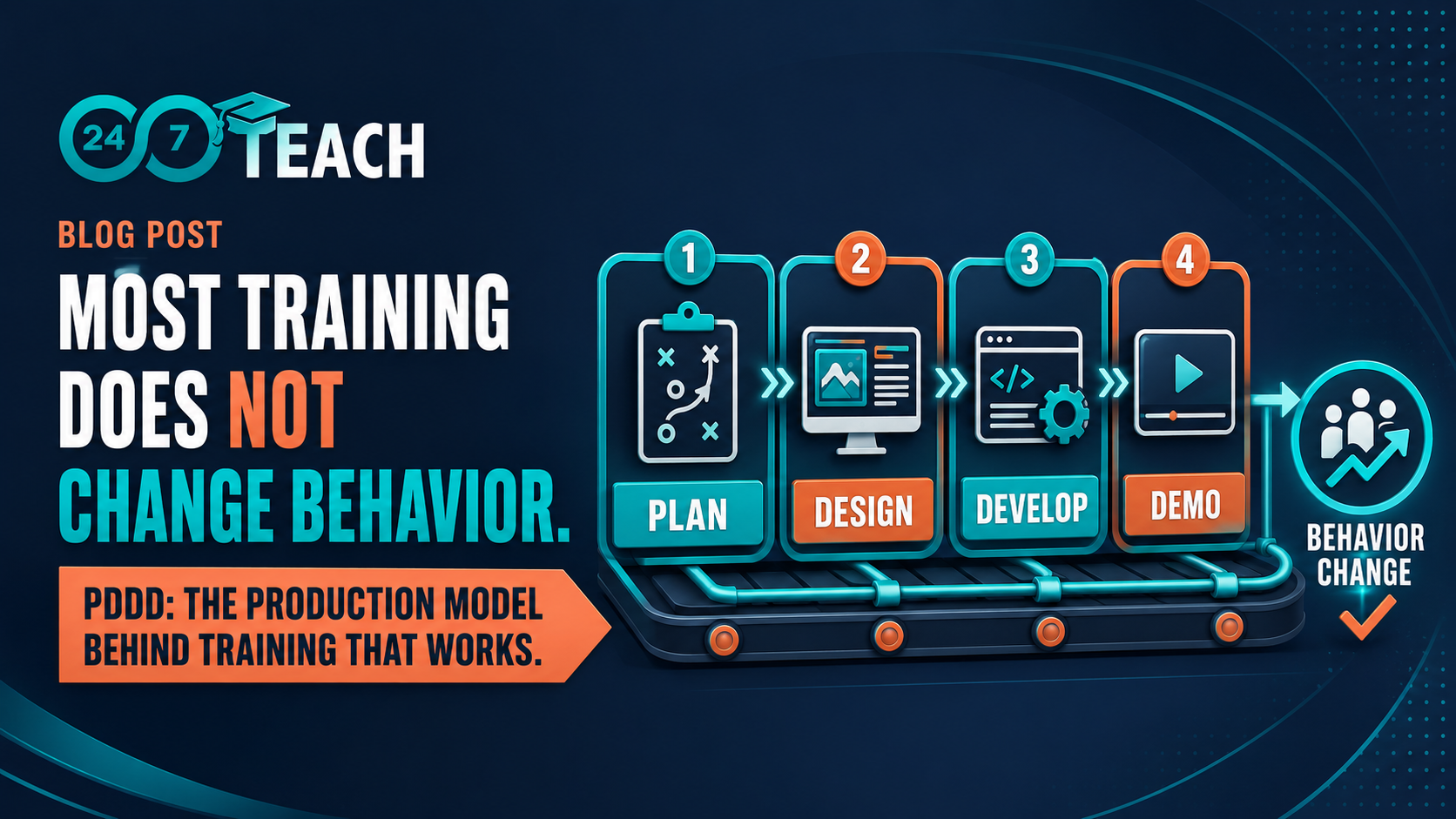
Every engagement we run for an organization is built on a single production model. We call it PDDD: Plan, Design, Develop, Demo, held together by evaluation and outcomes rather than by a calendar.
If you have looked at how we work, you have already seen PDDD wearing different words. Our engagements open with a scoping sprint, where we interview your team and map the real workflow rather than the one written down. That is Plan. We then co-design the curriculum and tooling with your subject matter experts, and nothing advances without your sign-off. That is Design. We deliver in working pieces, where every cohort and every phase produces something real, a plan, a tool, a rollout, not a status update. That is Develop and Demo together. And we hand the running system to your internal champions with playbooks, because we plan for our own exit from day one.
The thing that makes this model work, for you specifically, is the fourth letter. Every phase ends in a demo, something working that you can see and react to, not a description of progress. A demo is the only honest test of whether a thing actually does its job. A vendor can tell you a module is on track. They cannot fake it working in front of your team. The demo collapses the distance between what was promised and what was actually built, and it does it early enough that fixing it is cheap. That is the difference between finding out in week three and finding out after you have paid for the whole thing.
The glue is evaluation, and it points to outcomes rather than outputs. We do not measure success in attendance, satisfaction scores, or slide count. We measure it in what changed: hours returned, dollars saved, live systems running, and people who can now do something they could not do before. A phase does not advance because the timeline says so. It advances because the demo proved it earned the right to.
One clarification on the Ford analogy, because it can be misread. This is not about standardizing your people or handing everyone the same generic course. Your team is not a Model T, and every engagement we run starts with a scoping sprint precisely because the work has to fit your goals, not our template. The analogy is about the production process. Ford's genius was a repeatable way to build something that had long been impossible to build well at scale. A repeatable process is exactly what high-quality training has always lacked, and PDDD is that process.
Note: This article was researched and written by Justice Jones with AI assistance, then reviewed and edited by our team. The studies cited belong to their original authors. The examples from our own work reflect our organizational practice.
The production line looks like the product
Here is the part that matters most, and it is the reason this is not a sales gimmick. The way we build is the same shape as the way we teach.
The learning model underneath everything we make is Learn, Do, Be. A learner studies something, applies it in practice, and becomes capable by demonstrating it. Our production model is Plan, Design, Develop, Demo. Both end in a demonstration. Both treat doing and showing, rather than absorbing, as the moment that counts. We build experiential learning experientially, which is why what we hand you is not a binder that sits on a shelf. It is something working that your team owns and can run without us. The factory and the product share the same DNA, on purpose.
The proof
This is not theory, and we do not measure it in vanity numbers. We have supported more than 50 partner organizations across school districts, workforce nonprofits, and employers. For a workforce nonprofit, we replaced a manual onboarding process that took three weeks with an AI-assisted system that takes about ten hours, and their team runs it without us. For a school district, we designed and delivered a district-wide professional development program that rolled out across six schools, with the facilitator playbook handed off so the district could run it the following year. For a mid-market employer, we co-designed an AI-assisted onboarding platform that is live in production, with staff upskilled to own the iteration. Across the portfolio, partners report meeting around 96 percent of the goals we set together, with real dollars saved. Those outcomes come from the production model, not from better slides.
We hold a few principles that we will not soften. Co-designed, never off-the-shelf. Human-led, AI-facilitated, with people in charge of judgment and craft, while AI accelerates the work around them. Outcomes over outputs. And we plan for our own exit, because success means your team runs the system without us.
The lesson is Ford's, for organizations
If you are responsible for whether your people can actually do something new, the lesson is the one Ford taught a century ago. Do not buy a product. Buy a production process. The reason most training does not change behavior is not that the topics are wrong. It is that almost no one has a repeatable way to produce training people actually use, and then own. That is the bottleneck we built to solve, and the model that solves it is Plan, Design, Develop, Demo.
Build something that ships. If your organization needs training, professional development, or AI integration that changes what your people can do, we work as a partner, not a vendor. Every engagement starts with a 30-minute call and a two-week scoping sprint that produces a written proposal with scope, timeline, and pricing before any commitment, and ends with the running system handed to your team. We respond to RFPs and handle district and corporate procurement. Seek an organizational partnership.
About the author
Justice Jones is an instructional designer, AI strategist, and former K-12 principal, and the co-founder and Chief AI and Strategy Officer of 24/7 Teach. He built the company to close the gap between what schools teach and what teens and professionals need to succeed. Through 24/7 Teach, he and his team have supported more than 50 organizations with custom training, professional development, and AI integration.