
On the team building Naomi-AI, the K-8 classroom platform from our sister company 24/7 AI, one of our developers spent weeks reaching for the most powerful model available for every task. Planning a feature, naming a variable, asking a one-line question, all of it went to the heavyweight. The work got done. He also sat through a two- to three-minute wait for responses that a lighter model would have returned in thirty seconds, and that friction quietly shaped how he worked. He stopped asking small follow-up questions because each one cost two minutes. Then he learned to match the model to the activity, reserve the heavy model for dense planning, and switch to the fast model for conversation. His description of the change was simple. He was no longer annoyed at his AI.
That is the whole subject of this piece, and it is more important than it sounds. The public conversation about AI fluency in 2026 has fixated on building agents. The literacy that actually compounds for a working professional is smaller, more granular, and almost never posted about: knowing which model to use for which task, knowing when to let a model think and when not to, and knowing when to confirm before the tool acts. Most people are skipping straight to the hard, glamorous part and missing the basics that determine whether AI saves them time or wastes it.
"Use AI" was never a skill
The most useful frame for this came from Wharton professor Ethan Mollick, who coined the term "jagged frontier" to describe how AI is strong at some tasks that look hard and weak at others that look easy. The capability is uneven in ways you cannot predict from the outside. That unevenness is the reason "Do you use AI?" is the wrong question. The right question is which task, with which model, in which mode.
Mollick's research team gave these real numbers. In a field experiment with consultants at Boston Consulting Group, later published in Organization Science in 2026, consultants working inside the frontier finished about 12 percent more tasks, worked about 25 percent faster, and produced work rated roughly 40 percent higher in quality. On tasks outside the frontier, the benefit shrank or reversed, and some AI-assisted consultants performed worse than those working without AI assistance. Same people, same tool, opposite outcomes, decided entirely by whether the task fit the model's strengths.
This is why fluency cannot be a slogan. A marketer's good AI workflow is not a lawyer's, and a planning task is not a lookup task. The skill is the matching, and the matching starts with the model.
The model-selection decision most people get wrong
Around late 2024, a new category of model appeared. Instead of answering immediately, it paused and generated intermediate reasoning before responding. On a hard high school math benchmark, the previous flagship scored around 12 percent, and the thinking model scored around 74 percent. Nothing dramatic changed in the training data. What changed was when the compute was spent, at answer time rather than only at training time. That created the split every professional now lives with, whether they know it or not: reasoning models that think before they answer, and fast models that respond right away.
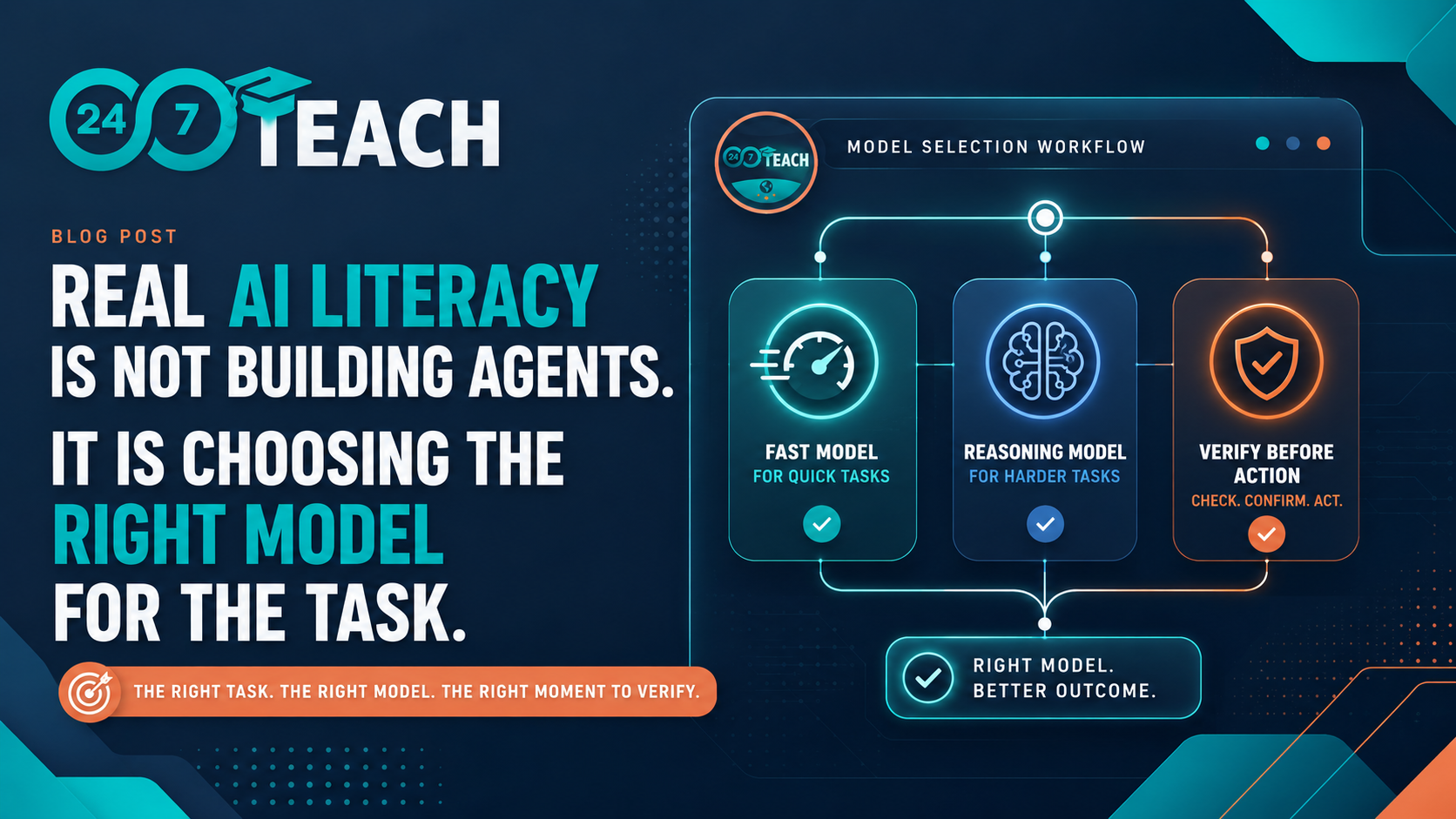
By 2026, the practical guidance has settled, and it is consistent across vendor documentation. Use a fast model for high-volume, low-stakes work: lookups, rewrites, classification, quick drafts, conversational back-and-forth. Use a reasoning model when a wrong intermediate step ruins the answer, or when the output is expensive to get wrong: multi-step planning, analysis, code that has to hold together, decisions you will act on. One model-selection guide put the everyday breakdown at roughly 60 to 70 percent of tasks running fine on the lighter, faster model. The point is not the exact percentage. The point is that defaulting to the heaviest model for everything, the mistake our developer made, is both slower and more expensive than most people realize, and defaulting to the lightest model for everything quietly degrades your hard work.
Here is the decision in plain terms. Before you pick a model, answer two questions. How costly is it to get this wrong, and how much does the wait matter? If the task is cheap to get wrong and you want it now, use the fast model. If the task is costly to get wrong and you can absorb the wait, use the reasoning model. The vendor-neutral advice from 2026 model guides says the same thing in different words: start with failure cost and latency, classify the task before you pick the tool, and only move up to the heavier model when the lighter one falls short.
The disclosure here matters for credibility. Our teams use Claude the majority of the time, so for us, the concrete versions are Anthropic's Opus tier for dense, sustained work and its Sonnet tier for fast iteration and conversation, as of mid-2026. The names will change. The discipline will not. Every major provider now ships a heavyweight reasoning tier and a fast tier, and the skill is the same regardless of which you use: classify the task, then choose.
The literacies that sit next to the model choice
Model selection is the clearest example of granular fluency, but it is not the only one. The same team that learned to match models also learned two other habits that no one posts about.
The first is confirming before the tool acts. One of our team members caught an AI coding tool about to merge work into the main branch, which is exactly the kind of action you do not want it taking on its own. She had built the habit of reading the plan the tool proposed before letting it run, and that one habit prevented a mess. As AI moves from answering to acting, this is the literacy that protects you. The model that drafts an email is low-risk. The model that sends it, files it, or merges it is not. Knowing the difference and slowing down at the moment of action are skills.
The second is knowing what has to be true and verifying it rather than assuming it. A colleague described front-loading context at the start of a task, then evaluating the output closely at the end, and treating those two moments as the places where the real time should go. Her rule of thumb is that AI gets you to about 60 or 70 percent on its own, and the climb to 90 or 95 percent comes from the context you provide up front and the evaluation you do at the end. The failure mode is assuming the middle 30 percent is fine because the first 70 percent looked good. She caught herself doing exactly that once, assuming a piece of work was done because she never actually checked it.
None of these is agent-building. All of them are examples of what fluency looks like in the hands of someone who values AI over friction.
*Note: This article was researched and written by Justice Jones with AI assistance, then reviewed and edited by our team. The studies cited belong to their original authors. The examples from our own work reflect our organizational practice.*
The honest counterargument
There is a real objection to all of this, and it deserves a straight answer. Will model routing and stronger models make the skill obsolete? Routing layers already exist that automatically classify a task and send it to the cheapest capable model, and frontier models keep getting better at more things. Mollick himself argues that the frontier is narrowing, and that tasks that reliably exposed AI's weaknesses a year ago are now handled.
Two things hold even so. First, routing does not remove the judgment; it relocates it. Someone still has to decide the acceptance bar, the failure tolerance, and which workloads can be trusted to automation. That decision is the literacy, and it does not disappear because a router executes it. Second, the agent story shows why capability is not the bottleneck. Gartner placed agentic AI at the peak of inflated expectations in 2026, found that only about 17 percent of organizations had actually deployed agents, while more than 60 percent expected to within two years, named agent-washing, the rebranding of ordinary automation as agents, as an explicit market problem, and predicted that roughly 40 percent of agentic AI projects will be canceled by the end of 2027. Those cancellations are not failures of model intelligence. They are failures of operational discipline, governance, and exactly the granular judgment this piece is about. The hard part was never the model. The hard part is the human practice around it.
Mollick has a useful way of putting the durable version of this. Where the output is all that matters, a general model will eventually match it. Where the process matters, the conversation, the judgment, the back-and-forth, the human stays central. Choosing the right model for the right task is a process skill. It compounds precisely because it is not the thing a model can do for you.
What this means for you this week
You do not need to build an agent to get materially better at AI. You need to be deliberate about three habits.
- Pick your model on purpose. Before your next non-trivial task, ask how costly it is to get wrong and how much the wait matters, then choose the fast model or the reasoning model accordingly. Notice how often you have been defaulting to one out of habit.
- Confirm before it acts. When you let an AI tool take an action rather than just produce text, read the plan first. Build the pause into your workflow so it is automatic, not a thing you remember to do.
- Verify what has to be true. Decide up front what would make the output correct, give the model that context before it starts, and check the output against it at the end, rather than trusting the first 70 percent just because it reads well.
These are unglamorous. They are also the difference between a professional who gets real leverage from AI and one who has a ChatGPT tab open and a vague sense of being behind. The agents will come. The literacy that makes them safe to use is the one you can start building today.
If you want a clear picture of where you stand before you start, our Career Translator is a free place to begin. Upload your resume, answer a few questions, and in about ten minutes, you get a readiness report, the future-proof roles your experience could move into, and suggested resume language that strengthens your positioning. No account needed. It is the fastest way to turn the habits above into a direction.
About the AI Fluency for Professionals Bootcamp.
About the AI Fluency for Professionals Bootcamp. For professionals ready to go further, 24/7 Teach runs a structured program for knowledge workers who want to build real, applied AI workflows rather than collect tips. It is built and taught by people who run an AI company, with cohort accountability and career services that include coaching through job transitions and consulting on high-level performance to secure a role or readiness for promotion once you are hired. If you want to go from using AI to being fluent with it, explore the bootcamps.
Justice Jones is an instructional designer, AI strategist, and former K-12 principal, and the founder and Chief AI and Strategy Officer of 24/7 Teach. He built the company to close the gap between what schools teach and what teens and professionals need to succeed, and he leads AI strategy at its sister company, Naomi-AI, a K-8 classroom platform. Through 24/7 Teach, he and his team have supported more than 50 organizations and placed more than 600 adults in new careers. Full bio →