"The best way to learn is the hardest to build. That is the production problem we set out to solve at 24/7 Teach."
Henry Ford is remembered for the car. His real invention was the way to build it. Before 1913, an automobile was a luxury good assembled one at a time by skilled craftsmen, which is why almost no ordinary person owned one. The moving assembly line changed the math. It dropped the time and cost of building a Model T far enough that the price fell year after year, and when Ford introduced the five-dollar workday in 1914, his own workers could afford the thing they were building. The product everyone remembers was downstream of a process almost nobody talks about. Ford did not democratize the car by making it better. He democratized it by inventing a better way to produce it.
That is the right way to understand what we set out to do at 24/7 Teach, and it is the honest origin of the framework I want to introduce here.
The thing worth democratizing
We did not set out to make learning cheaper or faster in the abstract. We set out to democratize a specific kind of learning, the kind that actually works: experiential learning. Learning by doing, by building, by demonstrating, rather than by sitting still and absorbing.
This is not a preference. It is one of the most settled findings in education research. In 2014, a University of Washington team led by Scott Freeman conducted a meta-analysis of 225 studies comparing traditional lectures with active learning across science and engineering courses. Students in lecture-based courses were about 1.5 times more likely to fail, and exam scores under active learning rose by roughly half a letter grade. The paper has been cited thousands of times, and its authors concluded that it is no longer reasonable to treat the lecture as the baseline, because the evidence that doing beats listening is overwhelming. John Dewey argued the same thing a century ago, and David Kolb built an entire learning model around the idea that experience, reflected on and applied, is how understanding forms.
So the best way to learn is not a mystery. We have known it for a long time.
The catch nobody likes to say out loud
Here is the catch. Experiential learning is the most effective form of learning and the hardest to produce effectively. That is exactly why most training is not experiential.
Anyone can record a lecture and upload it. You can produce a hundred hours of passive content on a laptop in a week. Building a real experience is a different animal. It requires a designed challenge, the right scaffolding, an authentic task, an assessment that measures whether someone can actually do the thing, and feedback that moves them forward. That is slow, expensive, and genuinely difficult to do well, which is why so much corporate and academic training quietly defaults to slides and a quiz, even though everyone involved knows it works worse. The effective thing is the hard thing to make. The market fills up with the easy thing instead.
This is the same gap Ford faced. The product people wanted was clear. The barrier was always production.
Where the field has already tried to solve this
Instructional design and learning development teams have wrestled with this for decades, and it is worth being precise about the lineage, because our framework grows out of it rather than ignoring it.
The dominant model in the field is ADDIE: Analysis, Design, Development, Implementation, Evaluation. It was built for the United States military, and it is thorough, but it is linear. You complete one phase before you start the next, the evaluation sits at the very end, and you often do not discover that something does not work until you have already built it. It is a waterfall, and waterfalls are slow and unforgiving.
In 2012, Michael Allen named that problem directly in a book titled Leaving ADDIE for SAM, and introduced the Successive Approximation Model. SAM is agile and iterative. Instead of one long march, it makes small, fast steps, builds rough prototypes early, and returns to improve them in repeated rounds. SAM was the right instinct, and the broader move toward agile, prototype-first design is the foundation we build on. We are not claiming to have discovered iteration.
We claim that iteration alone does not ensure quality. You can prototype endlessly and still drift. Something has to make each step honest. For us, that something is the demo.
Note: This article was researched and written by Justice Jones with AI assistance, then reviewed and edited by our team. The studies cited belong to their original authors. The examples from our own work reflect our organizational practice.
PDDD
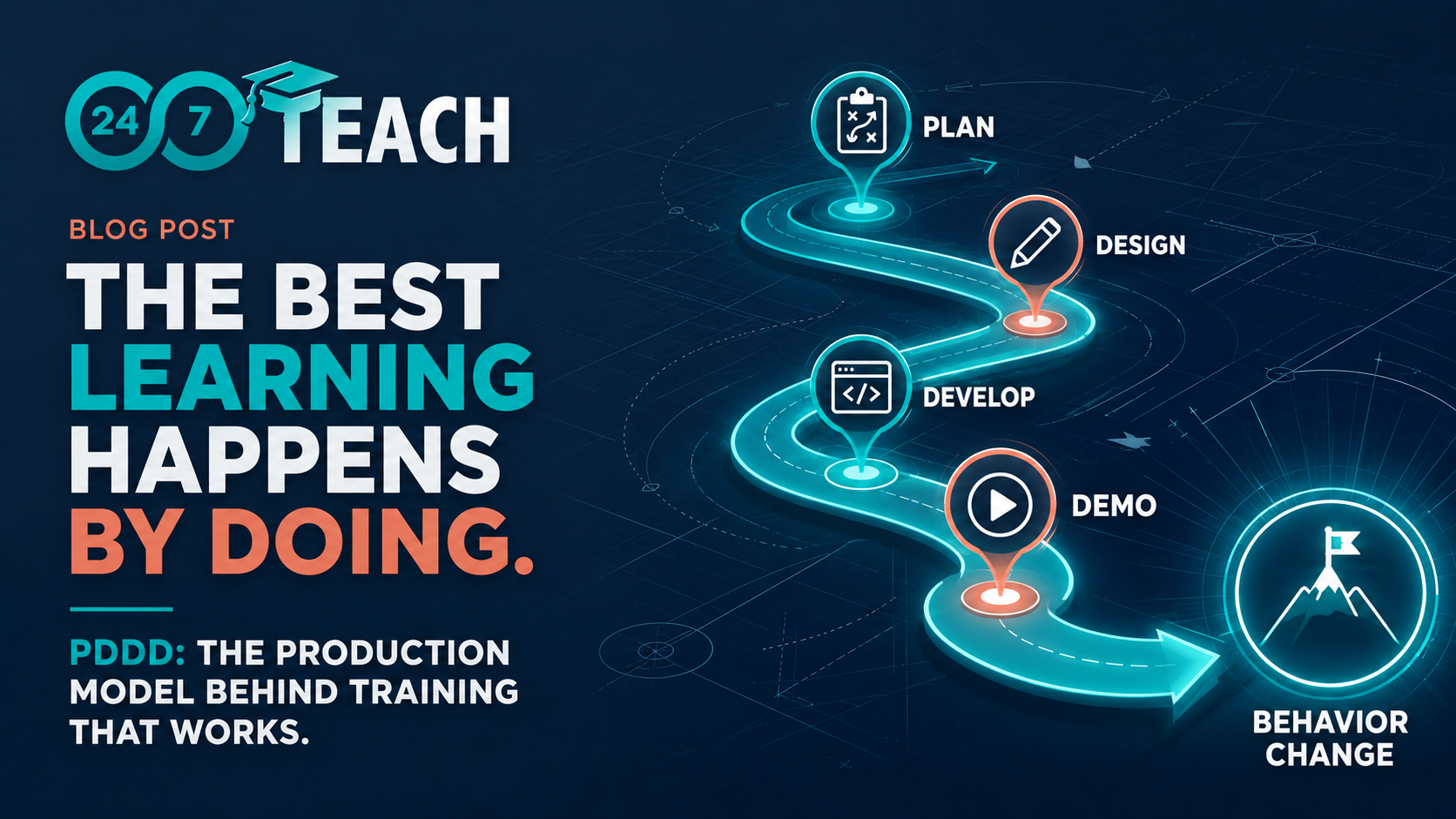
Our production model in the AI age is PDDD: Plan, Design, Develop, Demo.
Plan is where you decide what needs to be true and who the work is for. Design is where you shape the experience and the assessment before you build the whole thing. Develop is where you build it. Demo is where you put it in front of a real audience and show it working.
Two things make PDDD ours, and they are the whole point.
First, every milestone ends in a demo, not just the final build. This is the line that separates PDDD from ordinary rapid prototyping. In most prototyping, you demo when you reach the prototype. In PDDD, the demo is a recurring checkpoint, because a demo is the only honest test of whether a thing actually works. You can tell yourself a module is done. You cannot fake it working in front of an audience. The demo makes the audience real, exposes the gap between what you intended and what you actually built, and creates ownership, because the person demoing is on the hook for what they show. A demo is accountability you cannot talk your way around.
Second, evaluation and iteration are not a final phase. They are the glue between the steps. You do not advance from Design to Develop because a calendar says it is time. You advance because the demo and the evaluation proved you were ready. Evaluation is what holds the four letters together and what earns you the right to move forward. Pull it out, and PDDD collapses into a checklist. Keep it in, and it becomes a production line that refuses to pass defective work along, which is exactly what an assembly line is supposed to do.
A clarification, because the Ford analogy can be misread. We are not standardizing learning. Experiential learning is the opposite of a one-size product, and a learner is not a Model T. The analogy is about the production process, not the uniformity of the output. Ford's breakthrough was a repeatable way to build something that had once been impossible to build at scale. A repeatable process is precisely what experiential learning has always lacked. PDDD is that process.
Why does the production line look like the product
Here is the part that took us a while to see clearly, and it is the reason PDDD is not just a project-management trick.
The way we build is the same shape as the way we teach.
The first four stages of our learning framework are Learn, Do, Be, and Create Value. A learner studies the skill, practices it in a real context, begins to operate like the person who uses that skill, and produces something valuable with it.
Our production framework is Plan, Design, Develop, Demo. Both frameworks end in demonstration. Both treat doing and showing, rather than absorbing, as the moment that counts. The question is not simply, “Did they understand it?” The question is, “Can they use it, demonstrate it, and create value with it?”
We build experiential learning experientially. The factory and the product share the same DNA.
That is not a slogan we reverse-engineered. It is why the model works. A team that learns by demonstrating builds things that teach by demonstrating, because the instinct is the same. The demo is the hinge that connects how we work to what we make. We practice what we teach, in the most literal sense.
The proof
This is not a thought experiment. We run our instructional design bootcamp within PDDD, which means our learners do not take a course on instructional design. They plan, design, develop, and demo real artifacts from client briefs, just as our team does, and they graduate with a portfolio of work they built through actual demos rather than invented projects.
The outcomes follow from the production model. More than 200 graduates are now working in instructional design, learning experience design, and curriculum roles, having been hired by companies including Apple, Google, JPMorgan Chase, and Pfizer. On our Advanced track, roughly 73 percent are hired within six months, backed by a job guarantee. One graduate, Laura Campion, went from classroom teacher to our bootcamp to her first instructional design role to a learning and development leader at Pfizer, and she has said publicly that the path ran through here. Those results are not the product of better videos. They are the product of a better way to produce.
The lesson is Ford's
If you are trying to break into this field, the lesson is the same one Ford taught a century ago. Do not start with the product. Start with the way you produce it.
Experiential learning remains rare, not because anyone doubts it works. It stays rare because almost no one has built a repeatable way to make it. That is the real bottleneck, and it is the one we set out to solve. The framework that solves it is Plan, Design, Develop, Demo, held together by evaluation and iteration, and it is how we operate as an education and training company. PDDD.
Train inside the model. Our Instructional Design Bootcamp is built on PDDD, so you learn the craft by planning, designing, developing, and demoing real projects, not by watching videos. It is built for career-changers from teaching, training, and L&D, with two tracks, AI workflows woven through every project, and career services that include coaching through your job transition and consulting on high-level performance to secure a role or readiness for promotion once you are hired. The Advanced tier carries a job guarantee. See how it works.
About the author
Justice Jones is an instructional designer, AI strategist, and former K-12 principal, and the co-founder and Chief AI and Strategy Officer of 24/7 Teach. He built the company to close the gap between what schools teach and what teens and professionals need to succeed. Through 24/7 Teach, he and his team have placed more than 200 graduates into instructional design and L&D careers at companies including Apple, Google, and Pfizer.