
By Zaynah Danquah. Lead instructional designer and co-founder, 24/7 Teach. Reading time: 10 minutes.
Ask a team how much analysis is enough before they start building and you will get one of two answers. Either "we should really think this through," which means weeks, or "let's just ship something and iterate," which means nobody knows.
Both answers are a refusal to set a threshold. And with AI collapsing the cost of producing a first version, the second answer is winning by default, not because anyone decided it should.
Minimum viable analysis is the right idea. Reduce thinking to the essential questions that guide effective action, then move. The trouble is that "minimum" implies a quantity, and most versions of this advice never say what the quantity is or what it depends on. A team told to do the minimum amount of thinking, with no way to tell when they have hit it, will keep doing what they were already doing and describe it in newer language.
There is a threshold. It is not a feeling, and it is not the same for every decision.
The question the framework has to answer
Start with the part that is not in dispute.
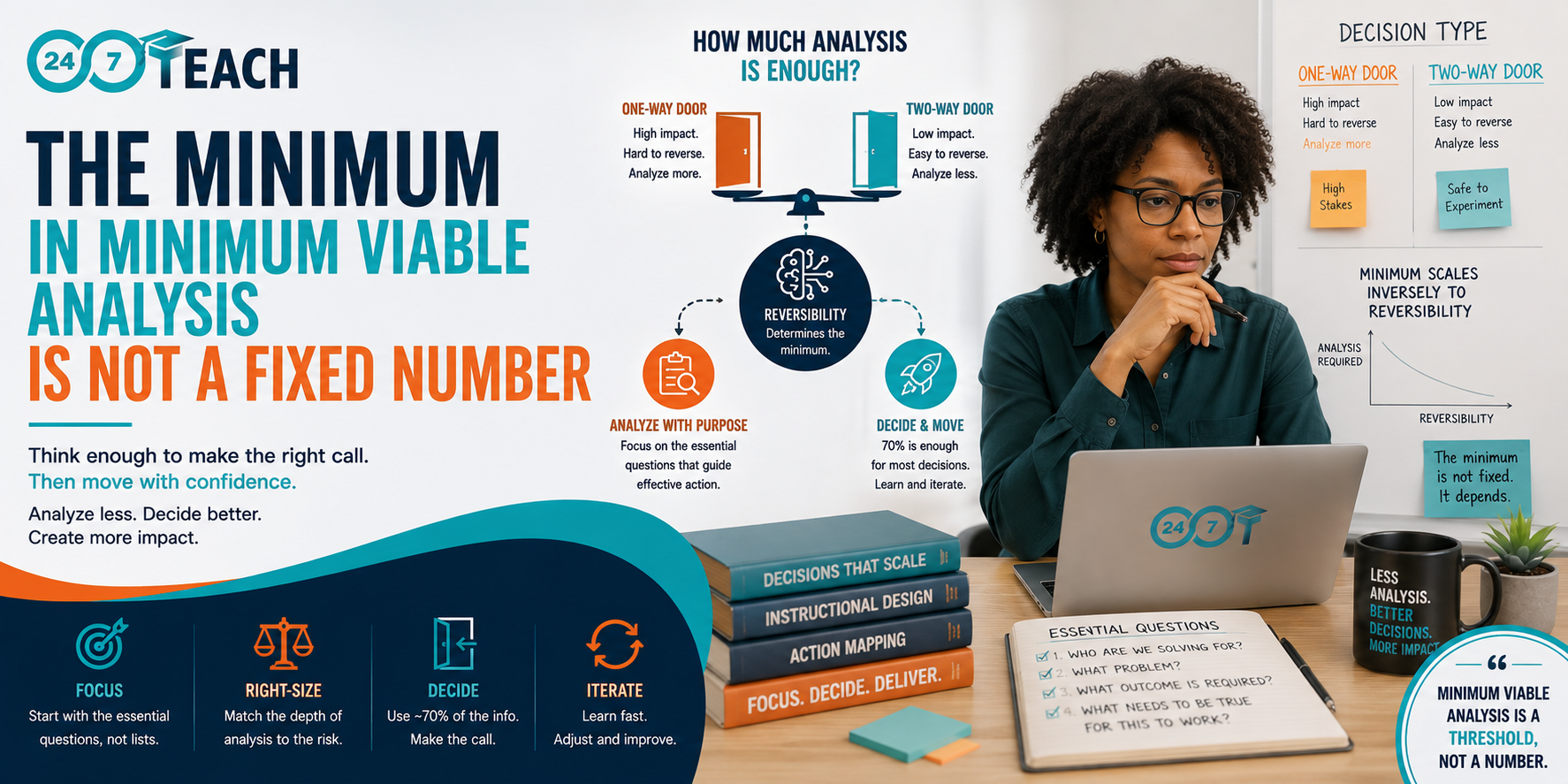
In fast-moving environments, excessive analysis has real costs. It delays feedback, delays learning, delays iteration, and manufactures a false confidence that the plan is sound because it was examined at length. High-velocity teams reduce analysis to a small set of orienting questions: who are we solving for, what problem, what opportunity, what outcome is required, and what needs to be true for this to work.
Those questions do real work. They are also close cousins of Cathy Moore's action mapping, which starts from the business goal and the observable behavior rather than the content, and they inherit its strength. Both refuse to let a team begin producing before it can say what the production is for.
But notice what they orient and what they do not. They tell you which direction to move. They do not tell you how long to stand still first. "What needs to be true for this to work" is an unbounded question. A team could answer it in ten minutes or spend three weeks on it, and nothing in the framework distinguishes the version that is disciplined from the version that is stalling with a worksheet.
The idea is older than the framework, which is useful rather than embarrassing. In the mid-1950s, Herbert Simon argued that people do not optimize, they satisfice: they set a threshold for what counts as good enough and take the first option that clears it. That is exactly the right model here. Simon's word for the threshold was an aspiration level, and his entire point was that satisficing only works if the level is set deliberately. Set it too low and you take the first bad option. Never set it at all and you are not satisficing, you are guessing.
So the framework needs one more piece: what determines the level.
The threshold is reversibility
In Amazon's 2015 letter to shareholders, Jeff Bezos separated decisions into two categories that turn out to be exactly the missing variable.
Type 1 decisions are consequential and effectively irreversible. He called them one-way doors: walk through, dislike what you find, and you cannot get back to where you started. Those decisions warrant slow, deliberate, heavily consulted analysis. Type 2 decisions are changeable. Two-way doors. If the call was suboptimal you reopen the door and walk back, so those should be made quickly, by individuals or small groups, without a heavy process.
His warning was about what happens when organizations confuse the two. As companies grow, they tend to apply the Type 1 process to everything, and he named the results plainly: slowness, unthoughtful risk aversion, too little experimentation, and less invention as a consequence. In the following year's letter he added the operating number most people remember, that most decisions should be made with roughly 70% of the information you wish you had, because waiting for the rest costs more than being occasionally wrong.
That gives minimum viable analysis its missing threshold.
The minimum scales inversely to reversibility. The cheaper it is to be wrong and correct course, the less analysis you need before moving. The harder it is to walk back, the more the analysis is not overhead, it is the work.
This reframes the whole question. Teams do not need to analyze less across the board. They need to stop spending a one-way-door process on two-way-door decisions, which is where almost all wasted analysis actually goes. A module outline, a prototype activity, a draft assessment, a first pass at sequencing: two-way doors. Rebuild them Tuesday if they are wrong. A platform migration, a certification claim, a partnership commitment, an assessment that gates a credential: one-way doors, and the deliberation there is not hesitation, it is proportionate.
The skill worth building is not moving fast. It is telling the two apart in under a minute.
Interactive
The reversibility check
Answer for one decision you are sitting on right now. The tool returns an analysis budget and which questions to answer before you move.
1. If this is wrong, how fast do you find out?
2. What does correcting it cost?
3. Who absorbs the cost if it goes wrong?
4. Does this touch any of the following?
Minors or student data, compliance or regulation, money, hiring, or a public claim about outcomes.
What AI actually changed
The common account says AI removed the need for heavy upfront analysis because production got cheap enough that drafts create clarity faster than planning does. That is half right, and the missing half is the important one.
Adoption is real and broad. Synthesia's AI in Learning and Development Report 2026, conducted with learning scientist Dr. Philippa Hardman across 421 respondents, found roughly 87% of teams using AI in training and development and about a third running it inside defined workflows rather than experimenting at the edges. Read the headline number with care, since the report itself notes it was distributed through AI-forward networks and likely overrepresents early adopters. A separate survey of 587 instructional designers run by Dr. Luke Hobson between April and June 2026 found close to half using AI daily, with time as the leading motivation.
But the analysis burden did not shrink. It relocated.
Researchers at Microsoft Research and Carnegie Mellon surveyed 319 knowledge workers who use generative AI at least weekly, collecting 936 first-hand examples of AI-assisted tasks. Their finding was not that critical thinking decreased. It was that critical thinking changed shape, shifting toward verification, integration, and what they termed task stewardship. Workers reported spending less effort gathering and generating, and more effort checking outputs against external sources and adapting them to a context the model did not know about.
The work did not disappear. It moved downstream of production, which is precisely where most teams have the least process.
That matters more in learning design than almost anywhere, because the downstream check was already the weakest link. Hardman's 2024 survey with Synthesia found instructional designers spending under 10% of their time on evaluation, the last phase of ADDIE and the first thing cut when a deadline compresses. Multiply production speed against an evaluation practice that thin and the gap does not hold steady. It widens. EDUCAUSE's June 2026 report, drawing on 438 faculty and staff, found genuine movement toward using AI inside assessment design alongside real uncertainty about how to verify what learners can actually do.
So the honest version of the AI claim is narrower and more useful than the popular one. AI reduced the cost of the first draft. It raised the cost of trusting one.
The trap inside the trap
The same study found something less comfortable, and it is the part worth sitting with.
Confidence in the AI predicted less critical thinking. Confidence in oneself predicted more. The people most likely to skip verification were the people least equipped to perform it, because a novice cannot see what is wrong with a fluent draft and therefore has no reason to look.
That is a direct threat to how minimum viable analysis usually gets adopted. The framework is most attractive to teams under pressure, and pressure is exactly the condition under which a plausible-looking output gets accepted rather than checked. The instructional designer eight weeks into the field, handed a generated module and a Friday deadline, will read it, find it coherent, and ship it. Not from laziness. From not yet having the pattern library that makes the flaw visible.
This is why the reversibility test cannot be applied by intuition alone in a team that is new to the work, and why the answer is not more upfront analysis. It is a defined check after production, run against a standard, by someone with the expertise to see what a fluent draft is hiding.
One caveat on the evidence: this study measured self-reported effort, not observed thinking quality. The direction is well grounded and the sample is substantial, but participants were describing their own cognition, which is a softer instrument than watching what they actually did.
Where minimum viable analysis is the wrong tool
Every speed framework needs a boundary, and this one has three.
Some doors only look reversible. A decision can be a two-way door for the organization and a one-way door for the person who owns it, because unwinding it costs them credibility even when it costs the company nothing. That asymmetry is real, it is rarely acknowledged, and it explains a lot of analysis that looks excessive from above and looks like self-preservation from inside. If your team keeps over-analyzing reversible decisions, the honest first question is whether reversing them is actually safe for the individual, not whether they understand the framework.
In education, the cheap-looking decisions are often the expensive ones. A weak module can be pulled next week. The learners who sat through it do not get the week back. Learner time is a one-way door wearing a two-way door's clothes, and it is the single sharpest limit on applying velocity thinking to instruction. A software team shipping a bad feature inconveniences users who can close the tab. A learning team shipping a bad module spends a resource nobody can refund.
Some categories are one-way doors regardless of how they feel. Anything touching minors or student data. Anything with a compliance or regulatory surface. Money. Hiring. Any claim about outcomes that a person will make a decision on. In those categories the minimum viable analysis is maximum analysis, and a team that has internalized the speed framework without internalizing this exception will eventually apply the 70% heuristic somewhere it does not belong.
None of this argues for slowing down generally. It argues that the reversibility test has to be run honestly, including on the decisions where the answer is inconvenient.
How we run this at 24/7 Teach
Minimum viable analysis is what makes our production loop fast. The evaluation standard is what makes it safe.
Our workflow puts the standard in the middle of the process rather than at the end. AI drafts first. A designer evaluates that draft against a defined rigor standard. A second AI pass critiques the evaluation itself, hunting for what the first pass accepted too easily. Then a realism check with someone who has actually taught the material, because a draft can be pedagogically clean and still be unrunnable in a real room with real time limits. Then iterate. We call it produce, evaluate, iterate with triangulated QA, and the triangulation is the point: three kinds of error, three different reviewers, no single pass trusted.
The rigor standard uses two lenses rather than one. Bloom's taxonomy for the kind of thinking a task demands, and Webb's Depth of Knowledge for how deep that thinking goes. One lens alone gets fooled, because a task can carry an impressive verb and sit at the shallowest depth available. "Evaluate the following three options" is a high-Bloom's verb attached to a recall task if the options are trivially different. Two lenses catch it.
The five orienting questions still run first, and they are still fast. What changed with AI is that we stopped treating the front of the process as the place where quality gets decided. Analysis before production sets direction. Analysis after production is what determines whether anything we made was any good.
This connects directly to the stopping rule we wrote about previously: the test of whether a constraint should be designed around or escalated. Minimum viable analysis is what makes that test cheap enough to run every time instead of only on the projects that already worry you.
What to do this week
- Take the decision currently slowing your team down and name the door. If you are wrong and find out in a week, what does correcting it cost? If the answer is a rebuild you can absorb, you are past the threshold already. Move.
- Find the two-way door you are running a one-way process on. Every team has at least one recurring approval or review cycle attached to something trivially reversible. That cycle is where your analysis budget is leaking.
- Move one hour from planning to verification. Not from planning to production. Take the hour you would have spent on a fuller upfront analysis and spend it checking output against a standard after the draft exists.
- Write down your standard. Bloom's plus Webb's Depth of Knowledge on assessment items is a workable starting point. Without one, "good enough" gets decided by whoever is most tired at 4pm on Thursday.
- List your one-way doors before you need the list. Minors and student data, compliance, money, hiring, outcome claims. Agree in advance that these do not get the 70% heuristic, because the decision to make an exception should never be made under deadline pressure.
Velocity is not the removal of thought. It is thought spent where it changes the outcome and withheld where it does not.
The teams that get this right are not the ones that think less. They are the ones that can tell, quickly, which door they are standing in front of.
About the Instructional Design Bootcamp
24/7 Teach runs an Instructional Design Bootcamp built for career-changers, with real portfolios and real client work rather than practice exercises. Career services include coaching through job transitions and consulting on high-level performance to secure placement or readiness for promotion once hired. More than 600 adults have been placed in new careers through our programs. See the bootcamp curriculum and next cohort dates
About the author
Zaynah Danquah is the lead instructional designer and a co-founder of 24/7 Teach, where she designs programs and curriculum across the company's teen, adult, and organizational tracks. Through 24/7 Teach, she and her team have supported more than 50 organizations and placed more than 600 adults in new careers. Full bio
This article was researched and written by Zaynah Danquah with AI assistance, then reviewed and edited by our team. External studies and sources are credited to their original authors. Examples from our own work reflect our organizational practice.