
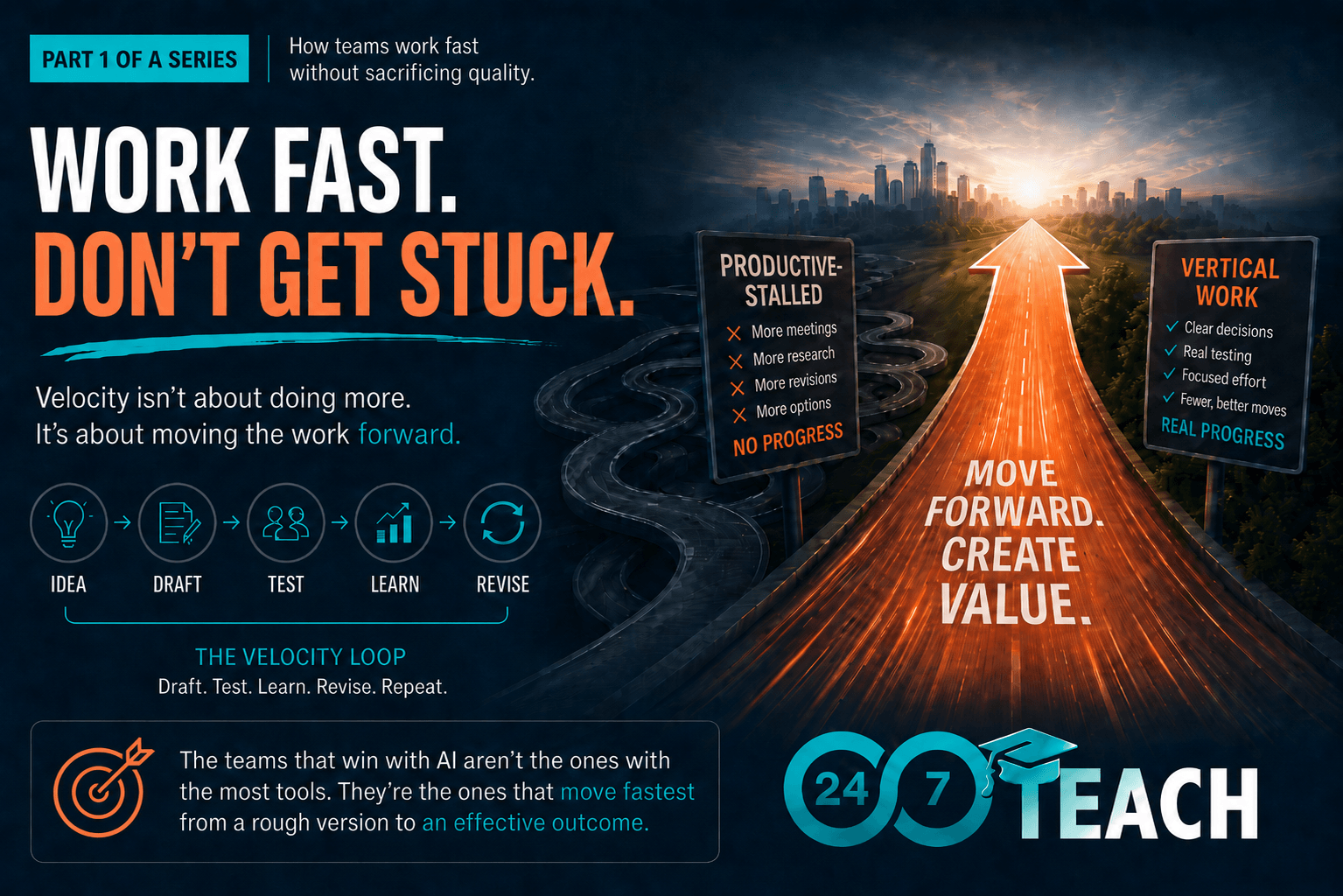
Part 1 of a series on how teams work fast without sacrificing quality.
AI has collapsed the cost of producing a first version of almost anything. A first draft, a first design, a first analysis, a first plan. The work that used to take a skilled professional a day now takes an afternoon, and sometimes a few minutes.
When production gets that cheap, production stops being the advantage. The scarce skill becomes something else: the ability to move from an idea to a good outcome quickly and repeatedly, without letting quality slide. Call it velocity.
Velocity is easy to confuse with being busy, and the two could not be more different. Busy is motion. Velocity is motion in a direction, fast, with the quality bar still intact. This piece is about what that actually means, the trap that quietly kills it, and why moving fast is a quality strategy rather than a corner cut. It is the first in a series. A later part will cover how to build this mindset across a whole team. This one is about understanding it.
The advantage moved from producing to iterating
For most of the history of knowledge work, the bottleneck was production. Making things was slow, so the people and teams who could make them well had an edge.
That edge is shrinking. When anyone can generate a competent first version in minutes, the differentiator is no longer who can produce. It is who can cycle fastest from a rough version to a genuinely good one: draft, test it against reality, learn, revise, repeat. Velocity is the disciplined speed of that loop.
The data is starting to bear this out at the organizational level. MIT's NANDA initiative reported in 2025 that roughly 95 percent of enterprise generative AI pilots produced no measurable return, and located the cause not in the technology but in how poorly organizations folded it into the way work actually flows. The teams pulling ahead are not the ones with the most tools. They are the ones that changed how fast they move.
Vertical work and horizontal work
To work with velocity, it helps to see that not all work moves a project forward, even when all of it feels like effort.
Picture any project as having a vertical axis and a horizontal one. Vertical work moves the project down toward a decision, a shipped version, a resolved question. Horizontal work spreads sideways: gathering one more round of input, opening another option to consider, researching a little more, polishing something that was already good enough.
Horizontal work is seductive because it feels productive and looks responsible. More options, more data, more reviews. But past a point, it stops adding value and starts substituting for progress. You can spend a week moving horizontally, generate a great deal of output, and end the week exactly as far from done as you started.
Velocity is a steady bias toward vertical moves. Not recklessness, not skipping the thinking, but a habit of asking, with each task, whether this is moving the work toward done or just widening it.
Here is the same week run two ways. A team is tasked with building a new onboarding workshop. The horizontal version: they spend the week surveying five departments for input, benchmarking four competitor programs, debating the perfect framework, and assembling a 60-slide research deck. Real output, genuine effort, and at the end of the week, there is still no workshop. The vertical version: they draft a rough version one of the actual workshop by Tuesday, run it past two real members of the target audience on Wednesday, and spend Thursday and Friday fixing what visibly broke. Same five days. One produced a deck about a workshop. The other produced a workshop that has already met a real learner. The second team will have a better program by the end of the month, not because they cared more, but because they spent their effort on the vertical axis.
The productive-stalled trap
The most dangerous failure mode is not laziness. It is the work that produces output and motion but no forward progress. I call it productive-stalled.
Productive-stalled work is the fourth revision of a deck that was ready two revisions ago. It is the analysis that keeps adding tabs nobody will read. It is the meeting that schedules the next meeting. It generates artifacts, it fills the day, it feels diligent, and it ships nothing. Because it looks like work, it is almost invisible. No one flags the person who is clearly busy.
This is a close cousin of what organizational researchers call the knowing-doing gap, the well-documented tendency of smart people and smart organizations to substitute talking, planning, and analyzing for the harder act of doing. The danger of productive-stalled work is precisely that it does not feel like stalling. It feels like care.
The first step is simply to name it. Once a team has the language, someone can say "I think this is productively stalled," and that sentence alone can unstick a week.
A short diagnostic helps tell productive-stalled work from legitimate diligence. Ask three questions of the task in front of you. First, if I stopped this right now, would the project actually be worse, or just less polished? Second, am I producing this for a real decision or a real audience, or for the comfort of feeling thorough? Third, when did this last move the work closer to being done, rather than wider? If a task is making things prettier, easing your own anxiety, and hasn't advanced the work in a while, it is almost certainly productively stalled. Legitimate diligence survives all three questions. The fourth slide revision rarely does.
Speed is a quality strategy, not its enemy
The deepest objection to velocity is that fast means sloppy. It is worth taking seriously, because it is exactly backward for most work.
Quality in modern work comes from iteration, not from polishing a first version in private until it is perfect. A version one that meets real feedback this week beats a version three that meets it next month. Hiding the work until it is flawless is not a quality strategy. It is a way to discover your mistakes later, when they cost more.
Jeff Bezos gave the clearest framing of this in his shareholder letters. He sorts decisions into one-way doors, which are hard or impossible to reverse and deserve slow, careful deliberation, and two-way doors, which are reversible and should be made quickly, then revisited if they go wrong. His warning is the relevant part: as organizations grow, they start running the slow, heavyweight process on reversible decisions too, mistaking deliberation for rigor, and grind to a crawl. He suggested acting at about 70 percent of the information you wish you had, rather than waiting for 90 percent, then correcting course fast.
Most of the decisions that fill a working week are two-way doors. Treating them like one-way doors is not quality. It is productive-stalled work, wearing a serious face. A deadline, used well, is the tool that forces a reversible decision to actually get made, which is why deadlines belong in a velocity toolkit rather than in opposition to quality.
AI as a thought partner, not a vending machine
AI is the obvious accelerant here, but most people use it in a way that produces the least velocity.
Used as a vending machine, you ask once, take the output, and ship it. That produces fast slop, which is worse than slow quality because it erodes trust. Ethan Mollick, the Wharton professor whose book Co-Intelligence is among the most useful current guides to working with these tools, frames the better approach in two of his rules: always invite AI to the table, and be the human in the loop. Bring it in early, at the thinking stage, not just the production stage. Use it to generate options, pressure-test your reasoning, and produce a fast version one you can react to. Then apply your judgment, because you are the one who knows what good looks like.
Mollick also describes AI's jagged frontier: it is surprisingly strong at some hard tasks and surprisingly weak at some easy ones, and the only way to learn where the edges are is to keep using it on real work. That is itself a velocity practice. The professionals getting the most from AI are not the ones who read about it. They are the ones iterating with it daily.
When speed is actually reckless
A piece arguing for velocity owes you the cases where it is wrong.
Velocity is disciplined speed, not speed at everything. One-way-door decisions, the irreversible, high-stakes ones, genuinely deserve slow deliberation, and treating them casually is how fast-moving teams blow themselves up. Some domains, including anything touching safety, legal exposure, or a person's wellbeing, reward caution over tempo, and a mature professional knows the difference rather than defaulting to fast.
There is also a real failure mode of speed without standards, which is just fast failure on repeat. Velocity is not the absence of a quality bar. It is holding the bar steady while shortening the loop. If a team drops the bar to go faster, that is not the velocity mindset. That is recklessness, and it earns the bad reputation that makes careful people distrust speed in the first place.
What this means for you this week
You do not adopt a mindset by agreeing with it. You adopt it by changing what you do. A few concrete moves:
- Look at your current task list and label each item vertically or horizontally. Notice how much of your week is horizontal.
- Find one productive-stalled loop, the revision or the analysis or the recurring meeting that keeps producing without progressing, and end it.
- Pick one reversible decision you have been over-deliberating, and make it at 70 percent certainty. Plan to revisit it, not to get it perfect.
- Invite AI in at the thinking stage of one real task, not just to produce the final artifact, and stay the editor.
- Put a real deadline on version one, and let it force iteration.
This is how we try to operate at 24/7 Teach. Our own site was built and shipped with AI tooling rather than handed to a slow agency process, our Customized Training for organizations is designed around iteration rather than one perfect rollout, and in one organizational engagement that approach met 96 percent of the client's stated goals while saving them about 28,000 dollars a year. Human-led, AI-facilitated is not a tagline for us. It is the working habit underneath the velocity.
The first version of anything is now cheap. The judgment to iterate it quickly into something good is not, and that judgment is the skill the AI era actually rewards.
In Part 2 of this series, we move from the individual mindset to the harder problem: how a leader or a learning team builds velocity across a whole group of people who were trained, for years, to do the opposite. If you want to build that fluency now, our AI Fluency for Professionals program is where we teach it directly.
About the author
Zaynah Danquah is the head of L&D at 24/7 Teach and the Chief Product Officer of Naomi-AI, a member of its founding team, where she leads product for the K-8 AI-powered learning platform built on a Human Led, AI-Facilitated approach. She originated the velocity mindset framework that shapes how her teams build and ship.