
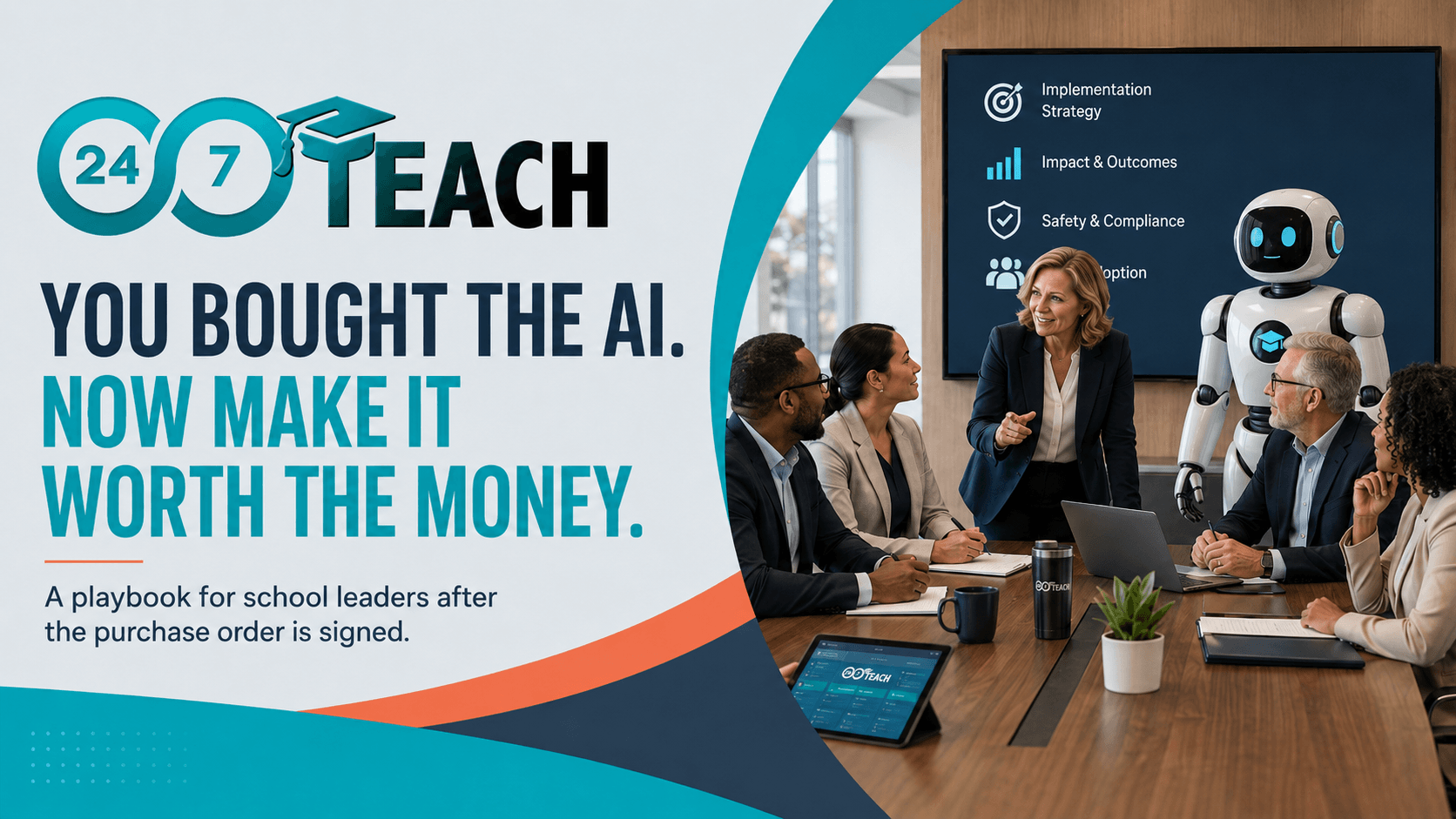
Across the country, schools and districts are buying ambitious, expensive AI faster than they are deciding what to do with it. The pressure is real, and feeling it is not a weakness. Boards ask what you are doing about AI, families ask, the vendor in the lobby has a persuasive demo, and standing still can look like falling behind. So the tool arrives with a launch event and a bold promise, and a few weeks later a quieter question shows up in the building: we own this now, so how do we make it worth the money?
That question is the one almost no one writes about, and it is the only one that helps a principal, executive director, or superintendent once the purchase order is signed. This is a playbook for answering it, whatever you bought.
The clearest current illustration is a San Diego charter network that reportedly spent $500,000 on two humanoid robots.
Most people will ask why, and it is a valid question. Striving to be innovative in education is not a crime; the network serves a genuinely challenging student population, and its catch-up model has a real track record of moving students the system had already lost once.
Here is the honest news for whoever is holding a receipt like that: success is still reachable. The catch is that you will not get there by chasing the vendor and marketing promises. You get there by redefining winning to something the tool can actually deliver.
Change the scoreboard before anything else
There is a trap here that sinks more of these efforts than anything else, so it is worth naming first.
If the scoreboard is some version of "the robot teaches better than a screen," the effort loses, and not because a team executed poorly. It loses because that is not something the technology can do this year. The strongest recent evidence in education points the other way from the hardware: well-designed AI tutoring can produce real learning gains. But that evidence is about the software, the model that asks good questions and adapts to a wrong answer, delivered on ordinary devices. There is no comparable evidence that a humanoid body wrapped around that software improves a single outcome, and the demonstrations so far suggest the body mostly adds latency.
So the first move is subtraction. Take "the machine improved test scores" off the table as the headline metric. It is the goal you are least equipped to hit and most likely to be judged on. Replace it with something the tool can plausibly move in a single semester, and make it something other than academic achievement.
The strongest candidate has been reached. Does the tool pull in chronically disengaged, credit-recovery students who were not showing up for human help before? If yes, and you measured it against a comparison group so it is a finding and not a story, that is a genuine, defensible win. It also quietly answers the sharpest criticism these purchases attract, the "you should have hired tutors" line, because it shows the tool doing something additive rather than replacing a human who was already reaching those kids.
Note: This article was researched and written by Justice Jones with AI assistance, then reviewed and edited by our team. External studies and sources are credited to their original authors. Examples from our own work reflect our organizational practice.
Repoint it at the jobs it can actually win
A tool like this usually ships configured for several roles at once. The San Diego robots were set up with four roles: a teacher, a college and career planner, a translator, and a wellness coach. Treating those as equals and staking the program on the hardest of them is the common mistake. They are not equally winnable, and the job now is triage.
Translation for families is the strongest bet, and it is not close. Real-time, multilingual communication with families is a real and underserved need for exactly this kind of student population, and it is a task language models handle reliably. It also does something a hallway of tutors was never going to do at scale, which reframes the tool as additive rather than substitutionary. Lead with it.
College and career planning is second because it produces a measurable outcome. A plan either exists or it does not, so you can show progress without commissioning a research study, as long as a counselor reviews what the machine drafts.
Direct academic teaching is the crowded lane with the weakest evidence for the hardware, so demote it from the headline. Let the tool answer content questions if a student wants that, but do not build the success story on it.
None of this is glamorous, and all of it means publicly doing less than the launch implied. That is exactly the trade worth making. A quiet, honest downgrade to two jobs done genuinely well beats a loud commitment to one job the tool cannot do.
Pick the job your AI can actually win
One question. Your answer points the tool at a job it can plausibly do well and hands you a metric you can defend in a board meeting. This is not a substitute for professional judgment. It is a starting point.
Handle the liability before you chase the upside
The wellness-coach role is the piece that can end a program on its own, and it deserves attention before anything else on this list, because it puts a school's credibility and a child's safety on the line, not just a metric.
An AI persona offering encouragement and coping strategies to teenagers, many from high-stress environments, is the highest-liability element in a purchase like this. I want to be careful rather than alarmist. The research on adolescents forming unhealthy attachments to responsive AI is still thin, and I do not have a verified study to cite for it, so treat this as a plausible risk rather than a settled finding. But thin evidence points toward caution, not comfort, when the users are vulnerable minors, and the downside is a child in distress getting a machine instead of a person. One bad interaction, with no offsetting results anywhere else, can define the whole story.
So either retire that role, or gate it hard: a written protocol that hands off to a trained human on any sign of distress, an explicit rule that the persona is never positioned as emotional or mental-health support, and a counselor in the loop by design. Safety here is not a feature of success. It is the precondition for being allowed to pursue it.
The same "get it in writing" discipline applies to data. Officials in the San Diego case have said the robots do not record and that memory is wiped after each interaction. Good, if true and documented. But for minors, on public money, a verbal assurance is not a safeguard. Get any such claim documented, independently verified, and shared with families in plain language.
Make the research real, or stop calling it research
When a purchase like this is announced as groundbreaking research, that framing invites scrutiny, it often cannot survive. In the San Diego case, the program was described as being the first of its kind to research physical AI as a teaching partner, and as of the reporting, no one has been able to identify a research partner, a study design, or a measurement plan. That gap draws the harshest criticism, and it is almost always self-inflicted.
There are two honest paths, and it is worth picking one on purpose. Either make it real research, which means partnering with an actual university school of education, securing institutional review, defining a comparison condition, and committing to a question before you know the answer. Or drop the word "research" and call it a pilot. Both are respectable. What keeps drawing fire is the claim of research without the apparatus of research. Close that gap or rename it, and do not paper over it by naming a study partner that does not exist.
Fix what is visibly broken, and publish either way
Two smaller things, both fixable, both worth catching early.
First, interaction quality. In the San Diego case, a reporter watched one robot deliver a lesson as a historical figure in a session full of stops and starts, speaking too fast, repeating its introduction several times while students scrambled to keep up, and the school's own dean reportedly called it clunky. Most of that is tuning, speech rate, and turn-taking, and it is fixable in configuration. But if the flagship demonstration is awkward, that awkwardness becomes the public story regardless of what else is true. Get the experience tight before the next observer walks in.
Second, commit early to publishing your results, whichever way they fall. If the reach metric moves, you are vindicated publicly, with data. If it does not, you become the rare school honest enough to say so, which is its own credibility and buys enormous trust for the next decision. The only outcome that reads badly is silence, because silence looks like hiding.
What this means for any leader who has already made the bet
Strip away the robot, and this is a general playbook because the underlying problem is general. The purchase gets made before the work that tells you what to measure, what to prioritize, and what to guard against. You cannot un-buy the tool, but you can do that work now, after the fact, and let it steer what comes next.
The sequence, even retroactively, is the same. Define the one problem you are actually solving, in a sentence, with a number. Point the tool at the narrow jobs it can win rather than the broad one it was sold for. Close the safety and privacy gaps before chasing any upside. Set a metric you can defend in a board meeting and a date to check it. Then decide, honestly, whether to expand, hold, or walk away.
At 24/7 Teach, we have supported more than 50 organizations through decisions shaped like this one, and the readiness-and-governance work that ideally comes before a purchase can almost always be retrofitted after one. It is less comfortable in that order, and it still works. We build in this space ourselves, through our sister company's K-8 platform Naomi-AI, which is why we hold a firm line on the difference between a tool pointed at a real job and an impressive object in search of a purpose.
Notice the thread running through every winning move here: the AI drafts, reaches, and assists, while a human decides, reviews, and teaches. That is the principle we build everything on, human-led and AI-facilitated. It is a narrower victory than the press release promised, and it is one you can actually reach.
About the author
I'm Justice (Justice Jones), founder and Chief AI and Strategy Officer, and a former K-12 principal, with over 20 years of experience in education leadership and Learning & Development. Today, I lead AI integration and build agentic AI systems in production for education and training companies, where "mostly works" simply doesn't cut it.
That work includes the seven-agent architecture and curriculum-design skills behind Naomi-AI at 24/7 Teach. This is where I write about what it actually takes to ship AI across K-12 schools, universities, and training organizations: the wins, the governance tradeoffs, and the failures included.