
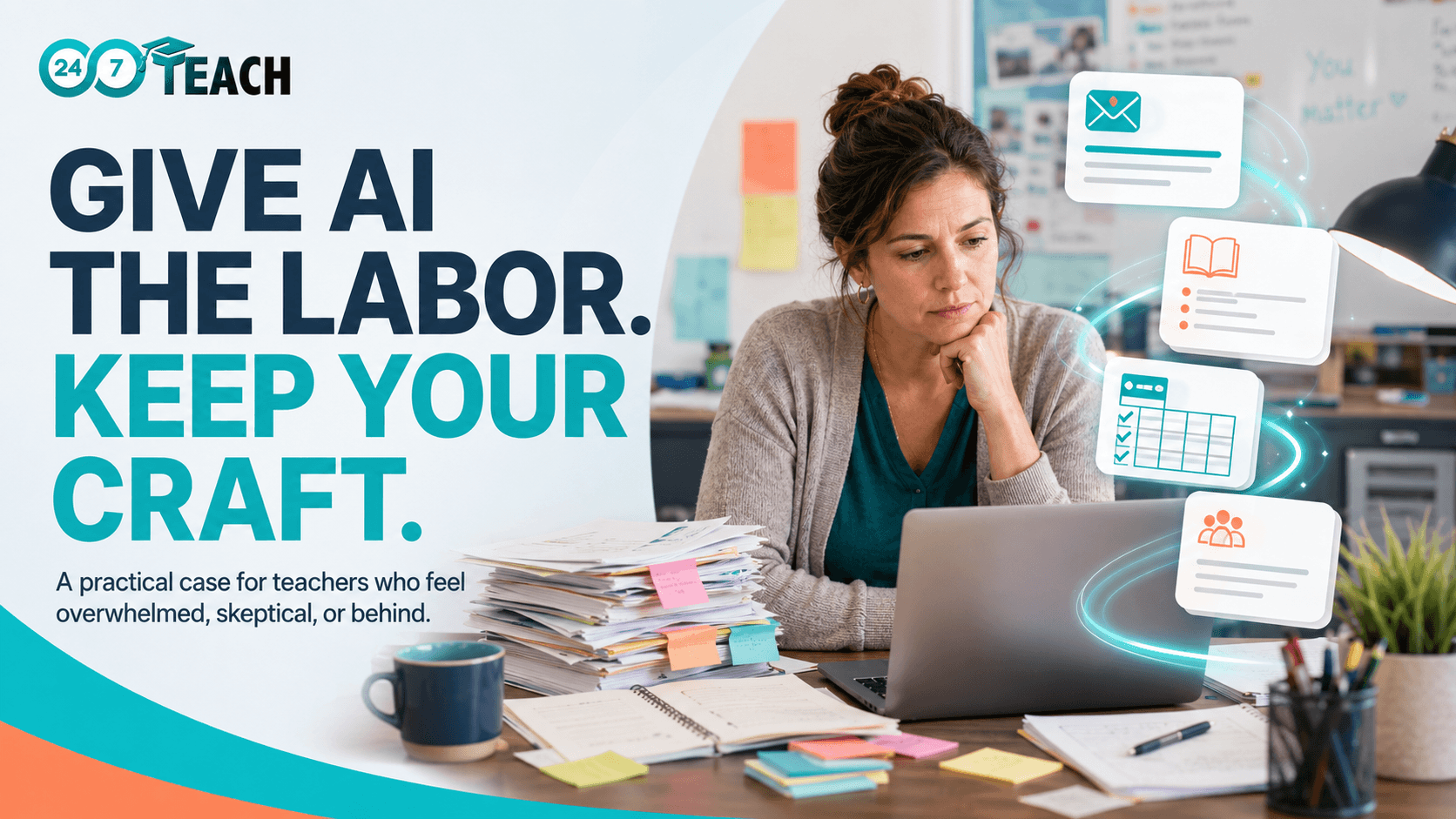
Let me be clear about which question this is. It is not the loud one, the one about whether students will use AI to cheat or skip the thinking. That debate matters, but it is not this one. This is about you, the teacher, instructional coach, or school principal. Whether AI belongs in your own practice: your planning, your grading, your materials, your Sunday afternoons. Whether you should bring it into the work, or whether it is one more thing that will cost you more than it gives.
I spent years as a principal, assistant principal, and instructional coach, which means I have watched a parade of technologies arrive with the same promise. Each one was going to save teachers' time. Most of them added a login, a dashboard, a training day, and a new way to feel behind. So I understand the reflex to be skeptical of the next miracle tool. That skepticism is earned, not Luddite. And if you are reading this with your arms crossed, or quietly scared of the whole thing, you are exactly the educator I am writing for. I also think AI is different in a specific way, and I want to argue both sides honestly before I tell you where I land.
The case for teachers using AI
The strongest argument is not hype. It is hours og time back.
The Walton Family Foundation and Gallup surveyed teachers in 2025 and found that those who use AI weekly save about 5.9 hours a week. Over a school year, that is roughly six weeks of time returned. And it comes from exactly the work that drains teachers without making them better: building worksheets and assessments, handling administrative paperwork, drafting the parent email, generating a reading at three different levels, and getting a rubric started. The RAND Corporation found the same pattern, that teachers overwhelmingly use AI for professional preparation, not to replace their instruction. They are offloading the labor, not the teaching.
And here is the part that matters most. When teachers were asked what they did with the time, the answers were not "more meetings." They said they gave more individualized feedback, built more personalized lessons, and got home to their families at a reasonable hour. Six in ten said they had more time for the actual work of improving teaching and learning. For a profession that leaves people prone to burnout, time is not a convenience. It is retention.
The quality gains are real, too. In the Gallup data, a majority of teachers who use AI for a task say it improves the result, not just the speed. Sixty-four percent said it improved materials adapted to specific student needs, and around 60 percent said it improved accessibility for students with disabilities, things like instant translation for a multilingual family or a leveled version of a text for a struggling reader. For a new teacher with no bank of materials and no planning period, an assistant who drafts a competent first version is not a crutch. It is the difference between drowning and staying afloat.
That is a serious case, and it deserves to be taken seriously by anyone tempted to dismiss the whole thing.
The case against, and the overwhelm nobody mentions
Now, the honest other side, because the surveys that report the time savings also report the catch.
Start with the catch itself. In the RAND data, 62 percent of teachers said the time AI saved them was partially offset by the time they spent reviewing and editing its output, learning the tools, and dealing with AI-related student behavior. The dividend is real, but it is not free. AI output is often generic and context-blind. It does not know your curriculum, your standards, or the kid in the third row who needs everything concrete. So you get a glossy draft that is subtly wrong or quietly off, and you spend your saved time fixing it. The danger in that loop is not wasted minutes. It is that you slowly become an editor of mediocre drafts instead of a designer of learning. And designing learning, struggling through how to teach a hard concept, and anticipating where kids will trip, is part of how a teacher gets better. Offload it entirely, and you can erode the very craft that made you good. This is the teacher version of deskilling, and it is the quietest risk on the list precisely because it feels like help.
Then there is the overwhelm, which the glossy case for AI almost never names. Teachers are not being handed AI with a plan. They are being handed a firehose. New tools every week, vendor emails, a colleague's must-try app, and somewhere above them an administrator who has not taught in a decade, telling them to innovate with AI by Monday. The support is not there to match the mandate. In the RAND survey, only about a third of teachers had received any formal training on AI, more than half learned what they know from personal exploration and social media, and while nearly four in five want real professional development, fewer than one in five districts had budgeted for it. The average teacher got about 12 hours of AI training in a year, compared with the 40 hours that the technology organization ISTE recommends as a floor. That is not adoption. That is abandonment dressed up as innovation, and it is a completely rational reason for a good teacher to want nothing to do with it.
If you lead a school or district and are not sure which side of that line your building is on, the free School AI Readiness Check will tell you in about ten minutes. Fifteen questions across governance, teacher fluency, privacy, instruction, and culture, and you get a report you can share with your cabinet, with next steps you can run this month at no cost.
And there are the familiar concerns that do not go away. AI states wrong things in confident, fluent prose, and unverified output with your name on it is a liability when it reaches a child. Student data and privacy are not optional questions when you are feeding work into a tool. And there is a labor question that teachers are right to ask out loud: if AI makes you more efficient, who captures that time? If the answer is that your saved hours quietly become a larger class or another duty, then the dividend was never yours. It was the building's.
That is also a serious case. Anyone selling AI to teachers who wave it away is not being honest with you.
Where does this lead us?
Here is the honest read. AI is a genuine gift to the teacher's labor and a genuine threat to the teacher's craft, and the entire outcome depends on which one you hand it.
The encouraging part is that the data show most teachers are already drawing that line correctly, using AI to prepare rather than to replace their judgment. The risk is drift: from using AI to draft a worksheet toward letting it design your unit, from using it to surface a pattern in the data toward letting it make the instructional call. The first is leverage. The second is the slow surrender of the thing that makes you a professional, rather than a content-delivery system.
My recommendation
So here is where I land, and it is the principle we at 24/7 Teach build on: human-led, AI-facilitated. For a teacher, that means three things.
- Give AI your laborious work. Hand it the work that drains you and never made you a better teacher: the formatting, the administrative paperwork, the first draft of the worksheet, the leveled versions, the parent email you have rewritten a hundred times. That is where six weeks a year live, and refusing it out of pride helps no one, least of all your students or your own evenings.
- But keep your craft. Do not hand over the design of learning, the diagnosis of why these particular kids missed this particular thing, reading the room, or the relationships. When AI shows you that 23 of 30 students missed the same question, that is the tool doing its job. Deciding whether they lack the concept or are just rushing, and choosing how to reteach it, is yours, and it must stay yours. You are the designer. AI is the assistant. Never let it flip.
- And get genuinely good at it. This is the leg that the gentle version of this advice omits, and it is the one that determines everything else. AI does not hand out its benefits evenly. Casual use gives you casual, generic, barely-worth-it results, which is exactly why so many teachers try it once and quit. The six weeks a year exist only for the teacher who has learned to direct the tool well. And there is a deeper reason than time: you cannot lead a tool you do not understand. Stay a novice, and the AI leads through its defaults while you follow, which is the exact opposite of human-led. Fluency is not a nice-to-have sitting atop the line I just drew. It is what lets you hold the line at all, because knowing the moment the tool slips from doing your labor to making your calls is itself a skill. Get good enough to catch it.
And on the overwhelm, give yourself permission that you are rarely given. You do not owe the firehose your attention. Pick one or two tools that kill your single biggest time-drains and ignore the rest of the noise without guilt. You are not behind because you have not tried the forty newest apps. And if you lead a building, hear this plainly: handing teachers AI without training, time, and a clear policy is not support, it is another unfunded mandate, and the time it saves belongs to teachers and students, not to the master schedule.
If you are scared of this, or you just hate technology
There is a version of you reading this who is not on the fence. You are dreading the whole thing. You did not get into teaching to manage software; you have watched tool after tool be forced on you, making the job worse, and underneath it is a fear you might not say out loud: that this one is different, that it is coming for you. I am not going to talk you out of any of that, because some of it is right. Let me just be straight with you, fear by fear.
It is coming for my job. Here is the honest version. AI is not going to replace you, and the research is on your side: a teacher working with AI beats AI working alone, every time, because the tool cannot read your room, build the relationship, or know why a kid who was fine yesterday shut down today. But I will not hand you a clean answer, because there is a real threat here. It is just not the one you have been sold. The threat is not the tool. It is a district that looks at efficiency and decides it can get by with fewer of you, or load more onto the ones who stay. That is a labor fight, not a technology fight, and you should fight it as one. Refusing to touch the tool does not protect you from that. It just leaves you with less standing in the argument.
Using it feels like cheating. It is not. Drafting a worksheet with AI is no more cheating than using a textbook, a worksheet a colleague shared, or a lesson you found online. The teaching was never the typing. The teaching is the judgment, the choices, and the knowing of your kids. You're keeping every bit of that, and handing off the busywork is not a shortcut. It is common sense.
I am too far behind, or too old, for this. There is no race, so you cannot be behind, and you do not need forty apps or a certificate to begin. But do not hear that as permission to stay casual, because casual is where AI disappoints almost everyone. One task, one honest try, is where you start, not where you stop. The goal is to get genuinely good at the two or three uses that fit your actual work, on your own timeline, and that is a real skill worth building. The colleague three doors down running ten tools is not the model. They are just a busier consumer of apps. The teacher to envy is the one who got good at a handful of things that matter.
"I do not have time to learn the thing that is supposed to save me time". Fair, and the people pushing this on you rarely admit it. So do not learn it. Try it once, on the single task you dread most this week, and give it fifteen minutes. If it does not help, quit; now your skepticism is evidence rather than a guess. The bar is not a transformation. The bar is one task.
"I got into this for kids, not screens." Then hear this clearly, because it is the part nobody tells the teachers who hate classroom tech. The best way for a teacher to use AI does not put a single screen in front of a single child. It happens at your kitchen table on a Sunday, on the paperwork that was already stealing you from your kids. AI taking your grading and your parent emails is not more technology between you and students. It is less. If you never want a device in your classroom, you can use AI and keep your classroom exactly the way it is.
"It will say something wrong, and I will look like a fool." It will say wrong things, so you check it before it reaches a kid, the same way you would glance over a worksheet a stranger handed you. And the instinct that makes you nervous about that is actually your edge. Spotting wrong content in your own subject is something you are already an expert at. That is not a weakness in the age of AI. It is the exact thing the tool needs from you and cannot do for itself.
So if you try one thing, make it this. Pick the single task you dread most this week: the sub plans, the parent email, the worksheet you have rewritten a hundred times. Open a free AI tool, no account required, and ask it in plain English the way you would ask a student teacher: write me this, for this grade, on this topic, at this level. Then judge what comes back the way you would judge that student teacher's first attempt. Fix it, keep it, or throw it out. That is the entire experiment. You are not betting your career or your values on it. You are spending fifteen minutes to find out for yourself whether this is help or hype. Either answer is worth having, and whichever way you decide, it's not the firehose.
If the whole idea overwhelms you, here is how it actually goes
Early last school year, I coached a middle school ELA teacher on lesson planning and intellectual prep, and her arc is the most honest answer I can give you, because it does not become a success story until the end.
At the first meeting, she was so overwhelmed that she resisted the whole thing. Not hostile, just underwater, the way you are when one more new thing feels like the one that finally breaks you. We did not force it.
At the second meeting, she had cooled off enough to try. And she was amazed by what it produced for about a minute, until she looked closely and saw that the output was generic and thin. Here is the part that matters, because this is exactly where most teachers quit. The problem was not the tool. The problem was that she had not yet learned how to ask it for what she actually wanted. She made a vague request and got a vague answer, which is all it can do with a vague request. The disappointment she felt did not prove that the thing was useless. It was proof that talking to it is a skill, and she had not learned it yet.
So we kept going. By the fifth meeting, something had flipped. She had found the specific places where it genuinely earned its keep: synthesizing a lesson, developing strong questions, and working out how to differentiate a lesson for her students with IEPs. Notice that those are not just busywork. They are close to the craft, and she stayed the one making the calls. The AI was the thinking partner. She was the teacher. And she was no longer the one being coached through it. She was the one telling me, with real energy, about all the different ways she had started using it and how much time it was giving her back.
If the whole idea overwhelms you, read that arc carefully, because the lesson is in the timeline. It took five meetings, not five minutes. She started underwater and resistant, which is to say she started exactly where you might be sitting right now. The teachers who come out of this fluent are not the ones who got it on the first try, because there is no first-try fluency. They are the ones who gave it a few honest reps, learned to ask better, and found the two or three uses that fit their actual work. Overwhelm is not a verdict on you. It is just the first meeting.
If you fear it takes the humanity out of teaching
This is the most legitimate worry on the whole list, and the one that is least about software. You are not scared of the tool, and you are not drowning in it. You are worried about what the job becomes, whether the relationship that is the entire point of teaching gets quietly engineered away. I will not wave that off, because it is pointed at something real.
But here is the reframe I would put in front of you. The thing draining the humanity out of teaching was never going to be AI. It was already happening, and it had a name long before any of this: paperwork, compliance, documentation, the administrative grind that pulls the best teachers out of the room and, too often, out of the profession altogether. The human part of teaching was already under siege by drudgery before a single chatbot showed up. So the honest question is not whether AI threatens the humanity of teaching. It is whether you aim it at the drudgery or at the relationship. Pointed at the paperwork, it hands you back the exact hours the human work requires. Pointed at the relationship, it is a betrayal, and you should refuse it without apology. The line this whole piece argues, give it your labor and keep your craft, is not a compromise with the humanity of teaching. It is a defense of it.
There is a real danger here, and I will name it rather than pretend it away. There is a version of this where a system replaces teacher time with a screen to save money, where AI gets used to thin out human contact instead of protecting it. That is not paranoia. It happens. But understand how you lose that fight: by sitting it out. If the teachers who care most about the human part refuse to touch any of it on principle, the people deciding how it gets used will be the ones who never valued that part to begin with. The profession needs its most human teachers fluent and in the room where this is decided, not boycotting it while it gets designed around them.
The teacher I coached is the proof I trust most on this. The time she got back did not leave her classroom. It went into her kids, her feedback, and her own life outside the building. AI did not take her humanity. It gave her the room to spend more of it.
What this looks like on Monday
Use AI to draft, then make it yours, because a generic worksheet that you do not shape for your kids is not a time savings, it is a downgrade. Let it surface the data and the patterns, then make the instructional call yourself. Verify anything before it reaches a student, because confidently wrong is the model's default failure mode. Protect your own planning thinking on the units that actually matter, even if AI could draft them, because that thinking is your professional growth and you should not automate it away. And refuse, out loud if you have to, to let the time you save quietly turn into more work.
The teachers who come out of this era stronger will not be the ones who banned AI, and they will not be the ones who handed it the keys to their craft. They will be the ones who knew exactly which work to give away, which work was theirs to keep, and got good enough at the tool to tell the two apart. Give it your labor. Keep your craft. Get good enough to know the difference. That is the whole job.
Bring this to your staff. We design professional development and AI integration for schools and districts on exactly this line, give AI the labor, keep the craft, taught by people who have led schools and coached teachers, not vendors. Every engagement starts with a scoping conversation and is co-designed with your team, with the training and time that real adoption actually requires. Partner with us on school PD.
Free · About 10 minutes
Where does your school actually stand?
Answer 15 questions across governance, teacher fluency, privacy, instruction, and culture, and get a report you can forward to your cabinet, with concrete next steps you can run this month at no cost.
Take the free assessmentAbout the author
I'm Justice (Justice Jones), Chief AI and Strategy Officer with over 20 years of experience in education leadership and Learning & Development. Today, I lead AI integration and build agentic AI systems in production for education and training companies, where "mostly works" simply doesn't clear the bar.
That work includes the seven-agent architecture and curriculum-design skills behind Naomi-AI at 24/7 Teach. This is where I write about what it actually takes to ship AI across K-12 schools, universities, and training organizations: the wins, the governance tradeoffs, and the failures included.