
By Zaynah Danquah Zaynah Danquah is the lead instructional designer and a co-founder of 24/7 Teach. Published August 17, 2026. Reading time: 11 minutes.
You bought the licenses. You ran the training. Attendance was fine, the feedback forms were positive, and three months later roughly the same handful of people are using the tools while everyone else has quietly gone back to how they worked before.
The usual diagnosis is that the training was not good enough, so the next move is more training. Better modules, more hands-on practice, a champions program, a lunch and learn.
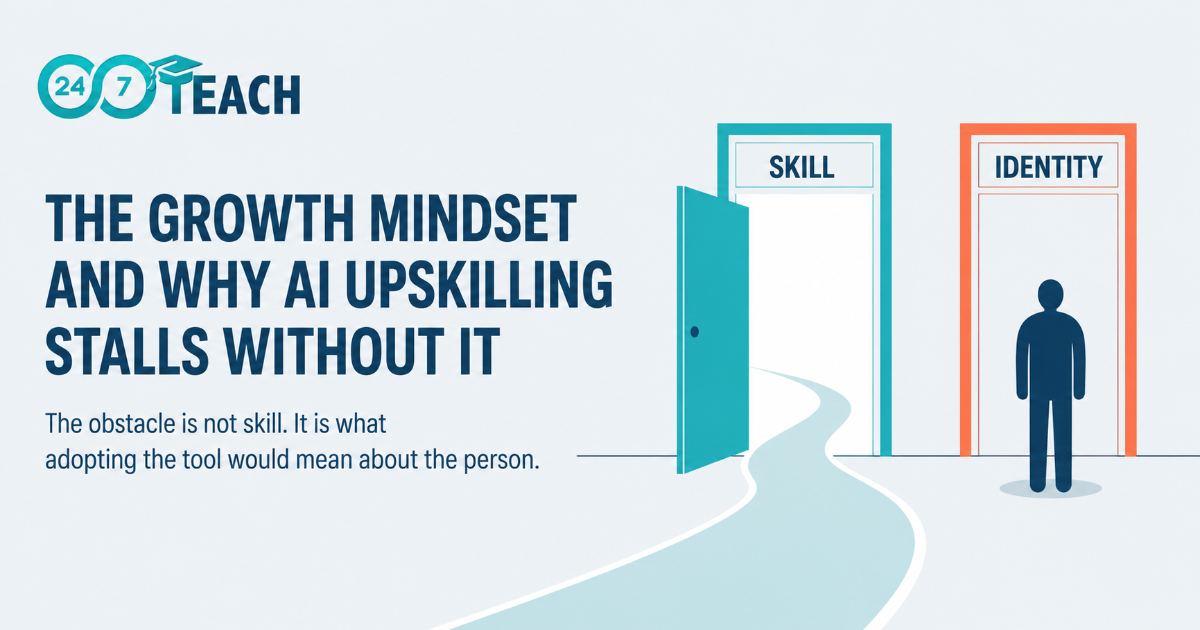
That diagnosis is wrong often enough to be worth checking, because it assumes the obstacle is skill. In most stalled AI rollouts the obstacle is not skill. It is what adopting the tool would mean about the person being asked to adopt it, and no amount of additional instruction touches that.
This is where mindset stops being a poster on a wall and becomes the thing your rollout is standing on. But you have to be careful about which claim you are making, because the popular version of that claim is not well supported and your smartest skeptic already knows it.
First, the part most people get wrong
If you have heard that growth mindset is oversold, you heard correctly.
Two meta-analyses led by Victoria Sisk and Brooke Macnamara pooled 273 studies covering more than 365,000 people and found that mindset accounted for roughly 1% of the variation in academic achievement. A second analysis of 43 intervention studies covering about 57,000 students found a small average effect with signs of publication bias. A larger 2023 review found no significant effect among the studies that best followed methodological standards. The most rigorous trial, published in Nature in 2019 with more than 12,000 ninth graders, did find real effects, but modest ones, concentrated among lower-achieving students, and dependent on whether the school culture already supported challenge-seeking.
So if someone tells you a mindset workshop will make your staff learn faster, the evidence does not support it.
Now notice exactly what all of that research measured: whether teaching students a belief raises their test scores and grades. That is a skill-acquisition question. It is not the question you are asking.
Your question is whether a forty-six-year-old account manager who has been good at her job for two decades will open the tool, use it on real work, and keep using it when it produces something wrong on the first try. That is an adoption question. Different literature, different findings, and the confusion between them is why this topic generates so much bad advice in both directions.
The structural difference is that a ninth grader has no choice about entering the room. Algebra is compulsory. So when researchers tested whether adding a belief about malleability speeds up learning for students who were going to attempt the material anyway, they found very little, and that result makes sense. The belief was not the binding constraint. Attendance already was.
An adult has a choice every single time. Nobody makes your account manager open the tool. She can decline for years, describe the decline as a preference, and remain employed while doing it. Entry is voluntary, which changes what the belief is actually governing.
For adults, the growth mindset is not mainly about how fast you learn. It is about whether you start.
That is the distinction the rest of this article rests on, and it splits cleanly in two. Mindset governs entry. Practice governs improvement. Once someone is in the room, the belief stops doing much work and the structured habits take over, which is where the strongest evidence sits. Collapsing those two into one claim is how most writing on this subject goes wrong in both directions at once.
It also explains why this matters more now than it did five years ago. Staying relevant used to be an occasional decision: learn a system, ride it for a decade. Now it is a repeated decision, several times a year, each one voluntary, each one carrying a small identity cost because attempting something unfamiliar in front of colleagues means being visibly bad at it for a while. Someone who believes their capability is fixed does not make that decision once and stall. They decline it forty times, quietly, each refusal sounding like judgment rather than avoidance. The compounding is what ends a career, not any single decline.
Skill barriers and identity barriers
Here is the distinction that makes the rest of this useful.
A skill barrier means someone cannot do the thing. They do not know the syntax, the workflow, or which button produces which result. Training fixes skill barriers. That is what training is for, and when the obstacle is genuinely skill, a decent workshop resolves it in an afternoon.
An identity barrier means someone could do the thing but doing it would cost them something about how they see themselves or how they are seen. It shows up as sentences that sound like preferences and are actually self-protection. I am not really a technology person. I prefer to do this myself so I know it is right. I do not want to become dependent on it. I have done this for twenty years without it.
Training does nothing for an identity barrier. You can teach someone every feature of a tool and they will still not use it, because the thing stopping them was never the feature list.
And there is a diagnostic here that costs you nothing to run. If training removed the obstacle, it was a skill barrier. If people completed the training and still are not using it, you were never looking at a skill barrier, and running more training is spending money on the wrong problem.
Most AI rollouts fail this test and respond by ordering more of the thing that already did not work.
Why AI specifically triggers this
Every technology rollout meets some resistance. AI meets more, and the reason is structural rather than attitudinal.
Most workplace tools change how you do the work. AI changes what the work is evidence of. If the thing you were valued for was writing the first draft, building the model, or producing the deck, and a tool now produces a passable version in ninety seconds, the tool is not just changing your workflow. It is making a claim about what your expertise was worth.
That claim lands hardest on your most experienced people, which is the opposite of what most rollout plans assume. Someone two years into their career has little invested in doing it the hard way. Someone twenty-two years in built an identity on being the person who does this well. Research by EY has documented broad workforce anxiety around AI, and SHRM has noted a subtler version that leaders often miss: employees may worry that visibly using AI will be read as laziness. That is not a skill gap. That is someone doing a status calculation and deciding the safe move is to keep quiet.
The economic backdrop makes it worse rather than better. Economists at Stanford, using ADP payroll records covering millions of workers, reported in their November 2025 revision that early-career workers in the most AI-exposed occupations saw a 16% relative employment decline, concentrated in occupations where AI automates rather than augments. That finding is contested and it is a working paper, but your staff do not need the paper. They have read the headlines. When you announce an AI upskilling initiative, some portion of the room hears a countdown.
You cannot train your way out of that, and pretending the fear is irrational guarantees you will not address it.
What the organizational research actually supports
The classroom research was about individuals learning content. There is a separate body of work about organizations, and it points somewhere more useful.
Elizabeth Canning, Mary Murphy, Katherine Emerson, Jennifer Chatman, Carol Dweck, and Laura Kray studied what they called organizational mindset: whether employees perceive their company as believing talent is fixed or developable. Across three studies, including one drawing on more than 500 employees at seven Fortune 1000 companies, employees who saw their organization as fixed-mindset reported cultures with less collaboration, less innovation, and less integrity, and they reported lower trust and commitment. Later experimental work found employees helped their colleagues more after a work-specific growth mindset intervention, which matters for AI adoption because most practical learning about a new tool happens between coworkers rather than in a training room.
I want to be straight about the evidence quality, because the previous section held other research to a hard standard. This work is largely perception-based and correlational. Coded mission statements against public review data, vignette experiments, employee self-report. It does not establish that a fixed-mindset culture causes distrust rather than the reverse. It is softer evidence than the meta-analyses that found mindset training does little for achievement, and anyone who tells you otherwise is selling something.
What it does support is narrower and still worth your attention: the signal an organization sends about whether ability is developable is associated with whether people trust it and cooperate inside it. For an AI rollout, that signal is not a poster. It is who gets picked for the pilot, what happens to the person whose first attempt produces something wrong, and whether "I do not understand this yet" is a safe sentence to say in your meetings.
Your people are reading those signals whether or not you meant to send any.
What actually moves adoption
Mindset is upstream, not sufficient. Here is what the evidence supports doing once you have diagnosed an identity barrier.
Separate learning from evaluation, visibly. If the first hands-on use of a new tool happens on work that gets assessed, you have guaranteed that your most experienced staff will avoid it, because they have the most to lose from looking incompetent. Give them a context where being bad at it is expected and unobserved.
Change what the tool is a claim about. The identity threat says the tool replaces your expertise. The accurate reframe is that the tool produces material your expertise has to evaluate, which is a real change in the job and an honest one. Researchers at Microsoft Research and Carnegie Mellon surveyed 319 knowledge workers and found that critical thinking did not decline with AI use, it shifted toward verification, integration, and stewardship. The experienced person's judgment becomes more load-bearing, not less. That is not a motivational reframe, it is what the research found, and it gives your twenty-year veteran an accurate reason to engage rather than a comforting one.
Point feedback at the work, never at the person. Kluger and DeNisi's meta-analysis of 607 effect sizes found feedback improved performance on average but that more than a third of feedback interventions made performance worse, with effectiveness declining as attention moved toward the self. In practice: "does this draft actually answer what the client asked" produces learning, and "you need to get more comfortable with AI" produces defensiveness. The second sentence is about them. It is also the sentence most AI rollout communications are built out of.
Build the verification loop before you scale the tool. The same Microsoft and Carnegie Mellon work found that confidence in the AI predicted less critical thinking, while confidence in one's own expertise predicted more. Your least experienced staff are the least likely to catch a fluent wrong answer and the most likely to trust it. Meanwhile, in learning teams specifically, evaluation was already the least-resourced phase: Dr. Philippa Hardman's 2024 survey found instructional designers spending under 10% of their time on it. Scaling production against a thin verification practice widens the gap rather than holding it steady.
Run structured debriefs on real use. This is the best-supported practice in the entire cluster. Keiser and Arthur's meta-analysis of after-action reviews, the debrief used by surgical and aviation teams, found an effect roughly ten times the size of mindset interventions, with the largest effects on complex ambiguous tasks that provide no built-in feedback. Which is what AI-assisted knowledge work is. Twenty minutes after a real task: what happened, what was supposed to happen, what explains the difference, what changes next time.
That is how we structure our own production work. AI drafts, a person evaluates against a defined standard, a second pass critiques the evaluation itself, and someone who has actually done the work checks whether it survives contact with reality. We call it produce, evaluate, iterate with triangulated QA. The point is that no single pass is trusted, and the standard sits in the middle of the process rather than at the end.
Where this argument gets misused
Two ways, and the first one is the dangerous one.
Treating every objection as a mindset problem. Sometimes staff resist a tool because the tool is bad, the workflow is incoherent, or the rollout asked them to add thirty minutes to a process that was already too long. That is not an identity barrier. That is accurate assessment, and it is the most valuable information in the building. The moment "you need a growth mindset about this" becomes available as a response, leaders stop hearing legitimate objections, and the phrase turns from a developmental idea into a way of relabeling disagreement as personal deficiency. If you take one thing from this article, take the diagnostic, and use it to find out which problem you have rather than to confirm which one you assumed.
Buying the workshop instead of changing the conditions. The classroom research is clear enough that a standalone mindset session should not be your intervention. Even the best-run trial found effects only where the surrounding environment already supported the behavior. If your organization pays for a mindset workshop and then continues to assign the pilot to the same three people, evaluate first attempts, and treat "I do not understand this yet" as a performance issue, the workshop is a rounding error against the signals your actual practices are sending.
The honest version of the claim is this. Mindset is not a lever you pull. It is a condition you either create or fail to create, mostly through decisions that have nothing to do with training.
What to do this quarter
- Ask your most experienced staff what using it would cost them. Not whether they find it useful. What it would mean about their expertise. You will hear the identity barrier in the first two minutes if you ask the right question and then stay quiet.
- Create one low-stakes context this month. Real work, no evaluation, no audience. The first hands-on use should be somewhere failure is expected.
- Audit your own language. Go through your last three AI communications and count sentences about people versus sentences about work. If most of your messaging is about adaptability, comfort, and attitude, you are pointing attention at the self, which is the category the feedback research identifies as the one that backfires.
- Put a verification standard in writing before you scale. Who checks AI output, against what, and what happens when it is wrong. Without this, faster production only means faster unverified production.
- Schedule twenty-minute debriefs on real AI-assisted work. Not on the tool. On a specific task. This has better evidence behind it than anything else in this article.
Your upskilling program is not failing because your people cannot learn.
It is failing because you asked them to adopt something that makes an implicit claim about what their experience was worth, and then handed them a tutorial. The tutorial was never going to answer that. Answer it directly, honestly, and in the design of the work rather than in a slide, and the training you already bought will start doing what you bought it for.
Related reading
This is the foundation piece of four. Growth mindset is the gate, whether someone enters at all. The other three are what you do once through it. The solutionist mindset needs a stopping rule covers when to stop adapting to a constraint and escalate instead. The minimum in minimum viable analysis is not a fixed number covers how much thinking a decision actually deserves. The senior mindset and why you need it in the AI age covers how judgment gets built when nobody is building it for you.
Customized Training for organizations
24/7 Teach designs AI upskilling programs around real work rather than tool tutorials, with verification standards and structured review built into the program instead of added at the end. We have supported more than 50 organizations and placed more than 600 adults in new careers. Talk to us about Customized Training
About the author
Zaynah Danquah is the lead instructional designer and a co-founder of 24/7 Teach, where she designs programs and curriculum across the company's teen, adult, and organizational tracks. Through 24/7 Teach, she and her team have supported more than 50 organizations and placed more than 600 adults in new careers. Full bio
This article was researched and written by Zaynah Danquah with AI assistance, then reviewed and edited by our team. External studies and sources are credited to their original authors. Examples from our own work reflect our organizational practice.