
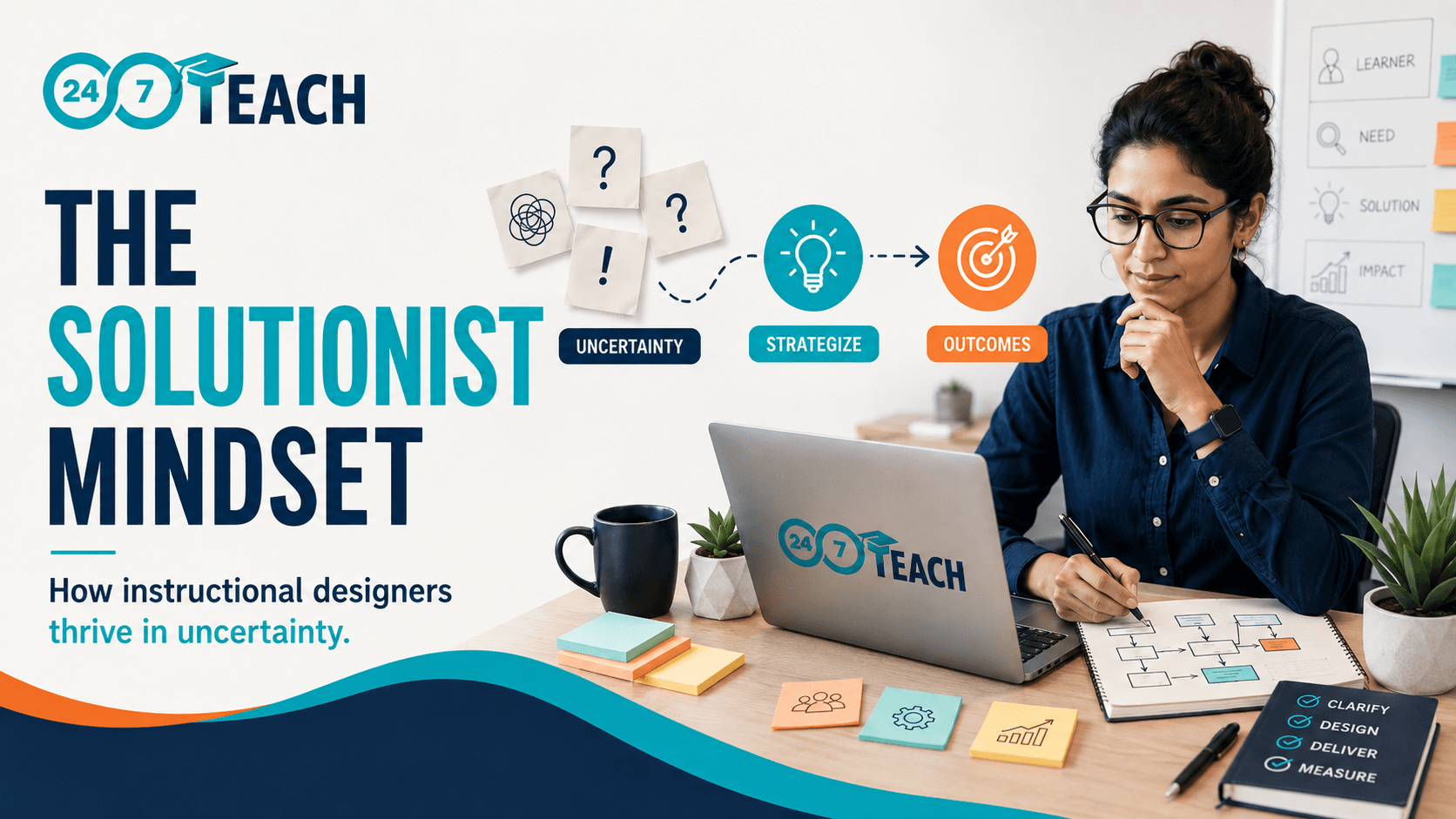
By Zaynah Danquah. Lead instructional designer and co-founder, 24/7 Teach. Reading time: 4 minutes.
Instructional design is a field defined by change. New technologies emerge every year, organizations shift their priorities overnight, and learners bring diverse needs that rarely fit neatly into a template. In this environment, success depends less on knowing every tool or method in advance and more on cultivating the right mindset: the mindset of a solutionist.
What does it mean to be a solutionist?
A solutionist is someone who is oriented toward outcomes rather than obstacles. Instead of being paralyzed when a plan derails or a platform is unavailable, a solutionist reframes the situation by asking:
- What is the real goal here?
- What resources are available right now?
- How can I move forward with value, even if it is not perfect?
This perspective does not deny challenges. It acknowledges them while refusing to let them block progress.
Why instructional designers need this mindset
Unlike fields where workflows are rigid, instructional design requires adaptability. Consider just a few common scenarios:
- A learning management system crashes the week before a program launch.
- A subject matter expert pulls out of a project, leaving content gaps.
- A client requests a solution that does not align with the real learning need.
In each case, the instructional designer has a choice: wait, stall, push back, or pivot. A solutionist clarifies the learning outcome, adapts with available tools, and communicates options confidently. This agility ensures that learning continues, even in imperfect conditions.
The cost of a non-solutionist approach
When instructional designers take a purely execution-focused stance, waiting for exact instructions or clinging to specific tools, progress slows and opportunities are lost. A non-solutionist mindset often shows up as:
- Limiting their approach to a single tool or method instead of adapting to the situation.
- Stopping progress when the original plan hits a snag instead of considering alternatives.
- Relying on other people or tools to resolve uncertainty instead of exercising judgment.
- Striving for perfection instead of delivering something of value.
The result is not just frustration. It is diminished impact. In contrast, solutionists move work forward, create momentum, and often spark innovations that would not have emerged otherwise.
Building the solutionist mindset
The good news is that solutionist thinking can be developed. Here are four practices that help instructional designers strengthen it:
- Focus on the outcome first. Ask: what should learners know, feel, or be able to do? Tools are secondary.
- Get comfortable with constraints. Treat missing resources or unclear directions as creative challenges.
- Prototype quickly. Build a draft using what is on hand rather than waiting for the "perfect" resource.
- Reflect and capture learning. After solving a problem, take time to note what worked, so you expand your future toolkit.
From designer to solutionist
Instructional design will only grow more complex as organizations demand faster, more flexible learning solutions. In this landscape, the most valuable instructional designers will not be those who follow instructions perfectly, but those who think critically, adapt confidently, and keep outcomes at the center of their work.
Being a solutionist is not about knowing every tool or anticipating every challenge. It is about approaching each obstacle as a design opportunity, one more chance to create meaningful learning experiences in spite of uncertainty. It is about transforming obstacles into opportunities.
Solutionists are problem-solvers, innovators, and leaders of learning.
Related reading
This piece describes the mindset. Two companion posts cover the limits of it. The solutionist mindset needs a stopping rule covers when to stop working around a constraint and escalate instead, and the minimum in minimum viable analysis is not a fixed number covers how much thinking to do before you move.
About the Instructional Design Bootcamp
24/7 Teach runs an Instructional Design Bootcamp built for career-changers, with real portfolios and real client work rather than practice exercises. Career services include coaching through job transitions and consulting on high-level performance to secure placement or readiness for promotion once hired. More than 600 adults have been placed in new careers through our programs. See the bootcamp curriculum and next cohort dates
About the author
Zaynah Danquah is the lead instructional designer and a co-founder of 24/7 Teach, where she designs programs and curriculum across the company's teen, adult, and organizational tracks. Through 24/7 Teach, she and her team have supported more than 50 organizations and placed more than 600 adults in new careers. Full bio
This article was written by Zaynah Danquah, then reviewed and edited by our team.