
Workshop Scenario:
Please think of yourself in the following scenario as you complete this workshop.
You are a college student just starting your career in a corporate job. It’s your second week in a fast-paced corporate environment and you find yourself both excited and overwhelmed. The constant stream of tasks, deadlines, and never-ending to-do lists have left you feeling stretched thin and struggling to maintain a healthy work-life balance.
Determined to regain control of your time and to achieve a better work life balance, you decide to sign up for a time management course offered by 24/7 Teach. You are eager to learn practical strategies that will help you navigate the demands of your job more efficiently.
In the last lesson, you were introduced to strategies that you can use to conquer and week and steps to do it.
In this lesson, you’ll explore how strategies that you can use to overcome resistance and distractions.
Lesson 3: Optimizing Your Calendar
This week our objective is to learn strategies to eliminate time wasting activities and overcome resistance and distractions.
With our winning weekly plans crafted, it's time to level our game further. This week, we're all about optimizing our calendars - learning to 'interrogate' our schedules and eradicate those sneaky time-wasting activities that hinder our progress.
Important Questions to Consider While Reading:
After 'interrogating' your calendar, what were some surprising insights you discovered about how you spend your time?
How do you plan to eliminate or minimize the impact of the time-wasting activities you've identified?
Can you identify any time-wasting activities that frequently sneak into your schedule? How do these activities impact your productivity and overall mood?
Understanding your Weekly landscape
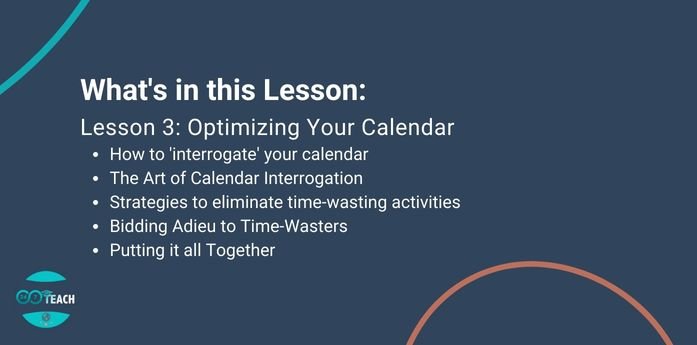
The Art of Calendar Interrogation
Interrogating your calendar might sound strange, but it's a superpower you can wield in the quest to conquer your week. Just as a detective interrogates a suspect to get to the truth, you must interrogate your calendar to uncover where your time is truly going.
Start by examining your past week's calendar. Ask yourself, "Did I spend my time on what truly mattered? Was there a balance between work, personal goals, and relaxation? Were there any instances where I was rushed or felt overwhelmed?" Reflecting on these questions will help you spot patterns, identify areas of improvement, and understand how you're really using your time.
Remember, the aim of this exercise isn't to make you feel guilty about how you've spent your time, but to empower you with the knowledge and insight to better align your future time allocation with your goals and priorities.
Bidding Adieu to Time-Wasters
Now that we've interrogated our calendars let's turn our attention to the activities that may be wasting our time. These are activities that don't contribute to our goals, yet somehow find a way to creep into our schedules and drain our precious time and energy.
Start by identifying these time-wasters. They might be excessive social media scrolling, unnecessary meetings, prolonged chatting with colleagues, or even tasks that could be automated or delegated. Awareness is the first step in reclaiming your time from these productivity bandits.
Once you've identified these time-wasters, strategize ways to eliminate or minimize them. For example, set specific 'social media time' slots in your day instead of sporadically checking your feeds. Decline meetings that don't require your presence or turn them into email conversations if possible. Use automation tools for routine tasks, and don't shy away from delegating tasks when you can.
Learning Checkpoint

Consider all areas of your life – professional commitments, personal tasks, family and social activities, relaxation, and hobbies. Draft a rough outline of your week on paper or in a digital planner. Allocate time slots for your tasks based on their priority and estimated duration.
Make a commitment to follow your plan for the week as closely as possible. Note any challenges or obstacles you encounter along the way. Don't forget to factor in buffer time for unexpected events; be realistic about how much you can achieve in a day.

Putting it all Together
Armed with the insights from your calendar interrogation and your action plan to tackle time-wasting activities, it's time to optimize your calendar. Redesign your schedule, keeping in mind to prioritize tasks that align with your goals. Allocate adequate time for each task, factoring in buffer time for unexpected developments.
Incorporate time blocks for relaxation and personal activities as well. Remember, the goal is to create a balanced an sustainable schedule. Your well-being is just as important as your to-do list, if not more.
In conclusion
Optimizing your calendar is a powerful strategy in your journey to conquer your week. By interrogating your calendar and eliminating time-wasters, you can make sure that your time and energy are invested in the activities that truly matter to you.
Congratulations on completing Week 3 of our Conquering Your Week Course! The skills you've learned this week are vital in ensuring your calendar is a tool that helps you, not hinders you, in achieving your goals.
Stay tuned for Week 4, where we'll dive into the topics of prioritizing and dealing with resistance to action. Until then, put these strategies into practice and take one step closer to mastering your week. Happy planning, and here's to conquering our calendars and our weeks!
Closing Assessment:

Select the Assessment button below to answer the following questions:
What does it mean to 'interrogate' your calendar, and why is this a beneficial practice in time management?
How does the process of optimizing your calendar contribute to overall productivity and well-being? Provide examples based on your own experience or hypothetical scenarios.
Lesson Assignment 3
This week, your assignment is to craft your winning weekly plan using the strategies discussed in the course.
Here are the steps:
Start by 'interrogating' your calendar for the past week. Reflect on whether your time was spent effectively and whether there was a balance in your activities.
Identify any time-wasting activities. Make a list and note how much time these activities are stealing from your day.
Develop a strategy to eliminate or minimize these time-wasting activities in the coming week.
At the end of the week, take some time to reflect on how this exercise impacted your productivity and overall feeling of control over your time.
Discussion Question:

1. Please answer the following question in the comment section below and interact with learners from around the world.
Share a surprising insight you discovered from your calendar interrogation and a time-wasting activity you plan to eliminate in our community forum. This exchange of experiences can offer valuable insights and tips to other participants, creating a positive learning community where we all grow together.
2. Please read and reply to other learners’ answers in the forum. Your replies should offer new substantiated ideas or thoughtful questions.