
Workshop Scenario:
Please think of yourself in the following scenario as you complete this workshop.
You are a college student just starting your career in a corporate job. It’s your second week in a fast-paced corporate environment and you find yourself both excited and overwhelmed. The constant stream of tasks, deadlines, and never-ending to-do lists have left you feeling stretched thin and struggling to maintain a healthy work-life balance.
Determined to regain control of your time and to achieve a better work life balance, you decide to sign up for a time management course offered by 24/7 Teach. You are eager to learn practical strategies that will help you navigate the demands of your job more efficiently.
In the last lesson, you focused on the crucial step of executing our carefully crafted plans and strategies.
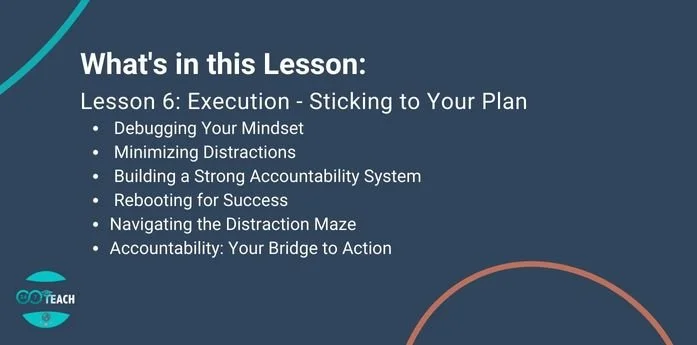
In this lesson, you will be introduced to elements of effective time management and productivity and how to reduce distractions and increase accountability.
Lesson 6: Mindset, Distractions, and Accountability
Hello, 24/7 Superstars! Welcome to Week 6 of our Conquering Your Week series. As we delve deeper into effective time management, we now focus on the triad that could make or break your productivity—Mindset, Distractions, and Accountability. These elements can influence how effectively we implement our weekly plans, ultimately shaping our overall performance.
Important Questions to Consider While Reading:
How does limiting beliefs or negative thoughts affect your mindset and how do you plan to counter it?
What strategies have you found most effective in minimizing self-distraction and blocking external distractions?
A Trilogy for Success
Debugging Your Mindset
Our mindsets—our attitudes and beliefs—dictate how we perceive and respond to the world around us. An empowered, growth-oriented perspective is vital for overcoming challenges, learning from failures, and striving toward our goals.
So, how do we debug our mindsets? The first step is self-awareness. Pay attention to your thoughts and beliefs, especially those related to productivity and success. Are you harboring any limiting beliefs or negative thought patterns that could be hindering your progress?
Once you identify such bugs, counter them with evidence, positive affirmations, and a shift in perspective. Remember, failures and obstacles are not permanent or defining; they're opportunities to learn, grow, and become more resilient.
Minimizing Distractions
Distractions are productivity's arch-nemesis. They come in all forms, both internal (like wandering thoughts, stress, and fatigue) and external (like social media notifications, background noise, and interruptions from others).
To tackle self-distraction, cultivate mindfulness. Practicing focused attention, whether through formal meditation or simply being present in whatever you're doing, can significantly enhance your concentration and ward off self-distractions.
For external distractions, create a work environment that promotes focus. Turn off non-essential notifications, communicate your work hours to others to minimize interruptions, and consider using noise-canceling headphones or white noise to block out background noise.
Building a Strong Accountability System
Accountability transforms intentions into actions. It's the bridge between planning and doing.
A strong accountability system might include the following:
Daily check-ins with an accountability partner.
Sharing your goals with others creates social accountability.
Even using digital tools that track and report your progress.
Remember, the best accountability system fits your preferences and motivates you to stay on track.
Learning Checkpoint
Have you ever had experience with accountability systems? Reflect on what methods have worked best for you and why.
How does holding oneself accountable for tasks and goals contribute to better time utilization? Think about a time in your personal experience where accountability positively impacted your ability to manage your time.

Mastering Your Mindset: Rebooting for Success
We are, in many ways, the architects of our reality. Our thoughts, attitudes, and beliefs often serve as blueprints, guiding our actions and shaping our experiences. Harnessing the power of a growth mindset that embraces challenges, celebrates effort, and views failures as learning opportunities can significantly elevate your productivity and overall performance.
Consider setting aside some time each day to cultivate your mindset. This might involve affirming positive beliefs, practicing gratitude, visualizing your goals, or engaging in personal development activities. Remember, developing a growth mindset isn't an overnight transformation; it's a journey of continual self-discovery, self-awareness, and self-improvement.
Navigating the Distraction Maze
In an age of information overload and constant connectivity, distractions have become an unavoidable part of our daily lives. However, it's within our power to minimize their impact on our productivity.
To minimize internal distractions, consider implementing mindfulness practices into your daily routine. Mindfulness trains your brain to focus on the present moment, making it a powerful tool in combating wandering thoughts and mental clutter.
Regarding external distractions, your environment can make a world of difference. Could your workspace do with some decluttering? Would a pair of noise-canceling headphones help block out distracting background noise? Could non-essential notifications be silenced during work hours? Minor tweaks to your work environment can substantially improve your focus and productivity.
Accountability: Your Bridge to Action
While self-motivation is crucial, having an external source of accountability can significantly boost your commitment to your plans. Whether it's a formal arrangement with a mentor or coach, a supportive peer group, or even a digital tool that tracks your progress, having a system that holds you accountable to your goals can be the difference between merely intending to do something and doing it.
Also, remember that accountability works best when it's a two-way street. Just as you can benefit from someone holding you accountable, you can motivate and inspire others by serving as their accountability partner.
In conclusion
In conclusion, the synergy of Mindset, Distractions, and Accountability forms the bedrock of effective time management. Throughout this section of our Conquering Your Week series, we've explored the impact of a growth-oriented mindset on our actions, techniques to minimize distractions, and the pivotal role of accountability in turning plans into accomplishments. As you progress, cultivate a resilient mindset, wield mindfulness to navigate distractions, and embrace accountability as the bridge to your aspirations.
In wrapping up this lesson, remember that these elements interweave to shape your success. Nurture your mindset, conquer distractions, and harness the power of accountability as you march towards becoming masters of time management. Your dedication to this trilogy will undoubtedly propel you forward, 24/7 Superstars!
Assessment Questions:
Select the Assessment button below to answer the following questions:
Describe the process of debugging your mindset and provide examples of any 'bugs' you've identified and corrected.
Describe your current accountability system. How effective has it been in helping you stick to your weekly plan?
Lesson Assignment 6
Think about the techniques you learned today.Dedicate a part of your day to mindset development, identify and minimize potential distractions, and set up a robust accountability system. Complete the activity below.
After noting your weekly observations, create an action plan detailing how to address identified issues. Be as specific and actionable as possible.
2. Write a brief reflection on your experience and the insights you’ve gained.
Discussion Question:

1. Please answer the following question in the comment section below and interact with learners from around the world.
How do mindset, distractions, and accountability interact to shape your approach to time management?
2. Please read and reply to other learners’ answers in the forum. Your replies should offer new substantiated ideas or thoughtful questions.