
INTRODUCTION
In this lesson you will…
Understand the significance of cybersecurity in education by identifying the three levels of impact (personal, operational and legal).
Reflect on the history and evolution of cyber threats in education.
ACTIVITY READING
Cybersecurity isn’t a new concern, but it’s grown into a much bigger and more personal challenge than ever before.
In this reading, you’ll explore three key levels of impact that cyberattacks have on your school and reflect on how cyber threats have evolved over time to become a daily risk.
-
Students: Breaches can expose sensitive data like grades, health records, or personal information.
Families: Stolen data can lead to identity theft or scams targeting parents.
Staff: Payroll scams, phishing, and personal email hacks can compromise your privacy and finances.
-
Daily Operations: Attendance systems, grading platforms and communication tools can all be shut down.
Instruction: Online learning tools and resources may become unusable during an attack.
District-Wide Systems: Payroll, HR and emergency communications can fail, affecting everyone. -
FERPA/COPPA Violations: Mishandled student data can trigger legal penalties.
Reporting Requirements: Breaches must be reported to authorities and the community.
Reputation: Legal fallout can damage trust with families and staff, sometimes for years.
PAUSE TO PROCESS
Take a moment to recall what you have learnt.
When you are ready, click the button to begin the activity.
REVISITING THE READING
The Evolution of Cyber Threats
Early Days:
In the 1990s and early 2000s, most cyber threats were simple viruses or annoying pop-ups.
Schools rarely thought about cybersecurity beyond basic antivirus tools.
The Shift:
By the 2010s, attackers began targeting people — using phishing emails and social engineering tricks to break in.
Schools became prime targets because they store valuable personal data and often have limited IT budgets.
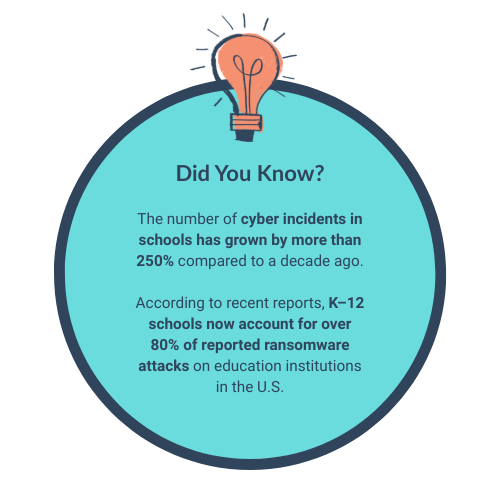 Click to enlarge [/caption]
Today’s Reality:
Fast forward to 2025, attacks are more sophisticated and relentless.
Phishing emails can look 100% real.
Ransomware can shut down entire districts for weeks.
Attackers don’t just aim for IT staff — they target teachers, office staff, even custodians — anyone with access to school systems.
JOIN THE CONVERSATION
Think back to your early experiences using technology in schools and respond to the following discussion questions:
What’s the biggest change you’ve seen in the risks or challenges your school faces today?
How has your own awareness or behaviour changed as a result?