
Scenario
Think of yourself in the following scenario as you complete this lesson:

Since learning about Natural Language Processing (NLP), you’ve been getting better at writing AI prompts, but something still feels off—ChatGPT’s responses aren’t quite hitting the mark. Maybe the answers are too vague, too detailed, or just not what you were expecting.
Frustrated, you bring it up with a colleague. They nod knowingly and ask, “Have you considered using a different language model?”
Wait—what? You thought ChatGPT was the only option.
Your colleague explains that while GPT models are powerful, different large language models (LLMs) are built for different use cases.
Intrigued, you decide to explore the world of LLMs, compare their strengths, and figure out which one best fits your needs.
By the end of this lesson, you’ll realize that mastering prompts is only half the equation—choosing the right AI model is just as important.
Your Objectives
By the end of this lesson, you should be able to do the following:
Explain what a language model is and how LLMs differ from SLMs.
Describe how LLMs generate responses.
Compare the output from various LLMs.
Select the most appropriate LLM for your teaching needs.
What is a Language Model?
Definition
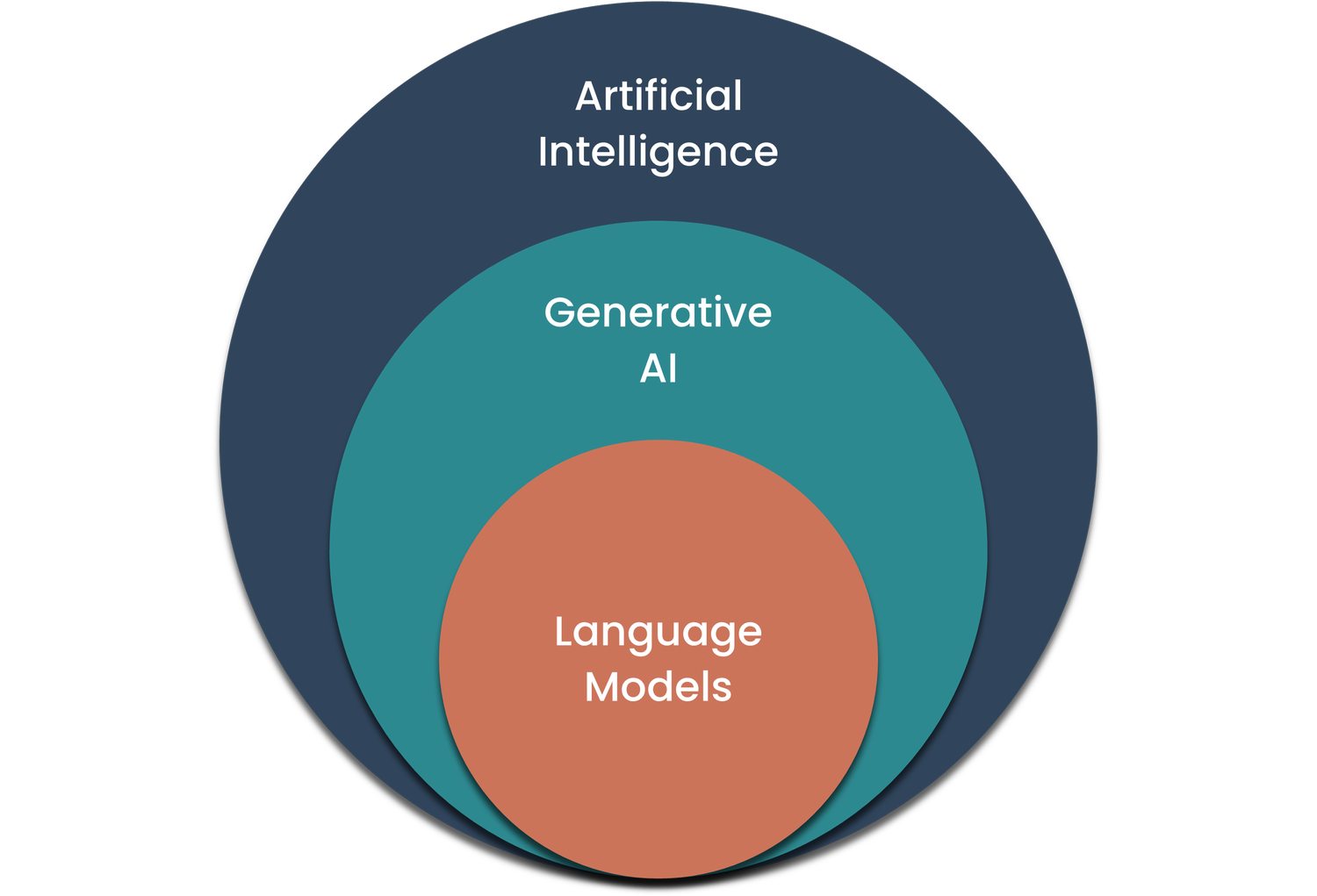
In Lesson 1.1 you learned about generative AI. Generative AI is a type of AI that specializes in creating new content, including text, images, and videos. In this lesson you will learn about language models. Language models are a type of generative AI that focus solely on understanding and generating text.
Small versus Large Language Models
Not all language models are the same. They fall into two main categories:

Small Language Models (SLMs): Trained on smaller datasets, these models have fewer parameters and are limited in their ability to process and generate text.
Large Language Models (LLMs): Trained on massive datasets, LLMs have significantly more parameters, allowing them to handle complex language tasks with higher accuracy and nuance.
In this course you will mostly be using LLMs like GPT because these models provide a rich understanding of language, generate high-quality responses, and support a wide range of use cases for educators.
Click the button below to complete a knowledge check:
How do LLMs Work?
Imagine you're teaching a computer to understand and generate human language. LLMs work by learning from vast amounts of text data and predicting what comes next in a sentence. They rely on four key concepts:

Machine Learning: Think of machine learning as teaching a computer by showing it lots of examples instead of giving it a fixed set of rules. Just like you learn to recognize patterns in spelling or math, an LLM studies millions of sentences to figure out how words fit together. The more examples it sees, the better it gets at predicting the next word.
Neural Networks: To make this learning possible, we use neural networks—a system inspired by the way your brain works! Imagine a web of tiny decision-makers that work together to recognize patterns in language . Each "neuron" in this network looks at a small part of a sentence and passes along what it learns to help make the final decision.
Deep Learning: Now, to make the neural network even smarter, we stack many layers of neurons—this is called deep learning. Think of it like learning a new language: at first, you start with basic words (one layer), then move on to grammar (another layer), then full sentences (more layers). With each layer, the model understands language more deeply.
Transformers: Here’s where things get really cool! Transformers are a special kind of deep learning model that revolutionized how computers understand language. Unlike older models that read text one word at a time, transformers can look at an entire sentence all at once. They pay special attention to how words relate to each other, even when they’re far apart in a sentence. This helps the model generate responses that sound natural and make sense.
How It All Comes Together
So when you type a question into ChatGPT, here’s what happens:

The model, trained using machine learning, looks at billions of examples.
Its neural network processes the words to find patterns.
Deep learning helps it analyze language in complex ways.
The transformer model decides which words best fit together to form a response.
The result? A reply that sounds just like something a person might say!
Click the button below to complete a knowledge check:
Beyond GPT: Other LLMs You Should Know About

If you’ve dabbled with AI in your classroom, chances are you’ve used ChatGPT. It’s one of the most well-known LLMs, but it’s not the only game in town!
There are other powerful LLMs out there—each with unique strengths that might be a better fit for your teaching needs. Whether you want a model that’s safer for students or better at pulling in real-time information, you have options.
Let’s break down six major LLMs you should know:
GPT (OpenAI): GPT (Generative Pre-trained Transformer), developed by OpenAI, is one of the most widely used LLMs due to its broad range of capabilities. It excels at generating lesson plans, summarizing texts, creating assessments, and even drafting emails. If you need a model that can assist with multiple tasks across subjects, GPT is a strong all-purpose option.
Claude (Anthropic): Developed by Anthropic, Claude is built with a strong focus on safety and reliability. This makes it a solid choice for schools concerned about responsible AI usage. If you want a model that gives thoughtful responses with fewer chances of misinformation or inappropriate content, Claude is a great alternative to GPT.
Gemini (Google): Unlike some LLMs that rely solely on pre-existing knowledge, Gemini is integrated with Google Search and provides real-time access to the web—something GPT doesn’t do in its free version. Also, if your school already uses Google Workspace (Docs, Slides, Classroom), Gemini is a natural fit because it’s designed to work seamlessly with Google’s ecosystem.
Llama (Meta): Unlike GPT, Meta’s Llama (Large Language Model Meta AI) is an open-source LLM, meaning it’s free to use and modify. This makes it ideal for teachers who want to customize it for specific needs. Unlike cloud-based models, Llama can also be run locally, allowing for greater control over data security. If your school or district has strict data privacy policies, Llama is worth considering
Mistral AI: Mistral AI specializes in lightweight, high-speed models that prioritize efficiency and low computing power requirements. This makes it an excellent choice for teachers who need quick responses and AI tools that run smoothly on various devices. If speed and efficiency are key factors for you, Mistral is a top contender.
Perplexity AI: Perplexity AI stands out because it leverages multiple LLMs instead of relying on just one. This means it can pull from different AI models to provide more comprehensive, well-rounded answers. Unlike other models, Perplexity AI also includes direct citations in its responses, making it an excellent tool for teachers who want links to verify information.
Which LLM is Right for You?
The best LLM for your classroom depends on your priorities.
Need an all-around assistant? → GPT
Need safer AI for student interactions? → Claude
Need real-time information and Google integration? → Gemini
Need customization and privacy? → Llama
Need fast responses on any device? → Mistral AI
Need well-rounded responses from verifiable sources? → Perplexity AI
AI isn’t just about automation—it’s about enhancing how you teach and how students learn. By choosing the right LLM, you can get the most out of AI while ensuring it aligns with your classroom goals.
Pause & Reflect
Conclusion
Well done! You now know what language models are, how they work, and why they matter. You explored the mechanics behind LLMs and saw how different ones serve different educational needs.
But there's more to uncover! In the next lesson, we’ll focus on GPT and what makes it one of the most powerful LLMs. Stay tuned!
Lesson 1.3 - Assessment
In Lesson 1.1 you prompted ChatGPT to generate a lesson for you. In Lesson 1.2 you revised your prompt to make it more effective. Now you will test your prompt in two different LLMs and compare the output from each.
Choose two of the following LLMs:
Llama (click “Try Llama on Meta AI”)
Copy and paste your prompt from Lesson 1.2 into both LLMs.
Compare the output from each LLM. What did you like/dislike about each response? Type your answer below:
Discussion Question
Connect with the education community by posting your discussion question responses in the comment section below.
Which LLM gave you the best lesson plan overall? Justify your answer.