
By Zaynah Danquah Zaynah Danquah is the lead instructional designer and a co-founder of 24/7 Teach. Published August 12, 2026. Reading time: 11 minutes.
Somewhere in your organization, someone has put the word "yet" on a wall.
The idea behind it is Carol Dweck's, and it is genuinely appealing. Believe your abilities are fixed and you avoid challenges that might expose your limits. Believe they are developable and difficulty becomes information rather than verdict. "I cannot do this" becomes "I cannot do this yet." The situation is unchanged. Your relationship to it is not.
It is a good idea. It is also one of the most oversold findings in education psychology, and if you work in learning you should know what the evidence actually shows before you build a program on it.
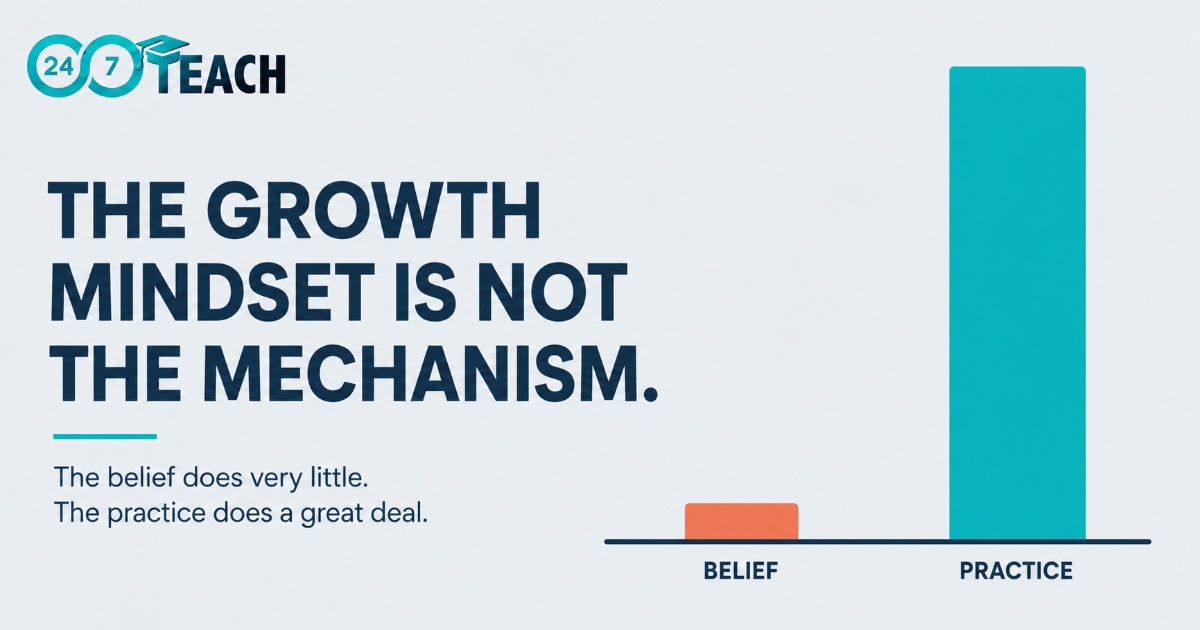
Here is the short version. The belief does very little. The habits people attach to the belief do a great deal. And the gap between those two facts is not an accident, it points at something worth understanding about how people actually improve.
What the evidence says
In 2018, a team led by Victoria Sisk and Brooke Macnamara ran two meta-analyses. The first pooled 273 studies covering more than 365,000 people to test how strongly mindset relates to academic achievement. Mindset accounted for roughly 1% of the variation in how well students did. The second pooled 43 intervention studies covering about 57,000 students to test whether teaching a growth mindset improves achievement. The average effect was small, and the authors flagged publication bias signals suggesting the true effect is smaller still.
They also found something more damaging than the size. About a third of intervention studies never checked whether the intervention actually changed students' mindsets. Among those that did check, roughly half found it had not. And in the studies where the mindset change succeeded, the achievement effect was not significant. If the mechanism is the belief, that pattern is backwards.
A larger 2023 review by Macnamara and Burgoyne covering 122 studies found no significant overall effect among the studies that most closely followed methodological best practices, and concluded that apparent effects are likely attributable to study design problems, reporting flaws, and bias.
Now the other side, and it deserves a real hearing rather than a dismissal.
The National Study of Learning Mindsets, published in Nature in 2019 and led by David Yeager, is the most rigorous test anyone has run: more than 12,000 ninth graders across 76 schools in a nationally representative sample, pre-registered, with independent data collection and blinded corroboration. It found real effects. Lower-achieving students who received a short online intervention improved core-course GPA by about 0.10 grade points. In medium- to low-performing schools where peer norms supported taking on challenging work, that rose to roughly 0.15 in core courses and 0.17 in STEM. Both lower- and higher-achieving students enrolled in more advanced math the following year.
Those are honest findings from a well-run trial. They are also modest. Macnamara's public response was that moving a student from a 2.0 to a 2.1 is not a large change, and she is not wrong. Two other details matter: the effects appeared for lower-achieving students rather than across the board, and they depended on whether the school culture supported the message. A mindset intervention in a school where challenge-seeking is socially punished did not do much.
So the fair summary is not "growth mindset is fake." It is: a nearly free intervention produces a small benefit for the students who most need it, in environments that already support the behavior it recommends. That is a real result. It is not the transformative lever it gets sold as, and if you built a program on the sales version, you built on the wrong number.
The number nobody puts on the wall
Set the mindset effect next to something else measured the same way.
Keiser and Arthur ran a meta-analysis of the after-action review, the structured debrief that militaries, surgical teams, and aviation crews run after an operation. Pooling 61 studies covering more than 900 teams and 3,400 individuals, they found an effect roughly ten times the size of the mindset interventions. A follow-up covering 83 studies and nearly 4,700 individuals found it larger still, and identified where it works best: complex, ambiguous tasks that do not give you obvious feedback on their own. Which describes most professional work.
Ten times. Same broad domain of "how do people get better," radically different magnitude.
The after-action review is not a belief. It is a procedure. What happened, what was supposed to happen, what accounts for the difference, and what do we do differently. It takes twenty minutes and no attitude adjustment whatsoever.
Now hold both numbers next to each other. The belief that ability is developable: very small effect. The structured practice of examining what happened and adjusting: large effect. Every growth mindset article you have read treats the first as the foundation and the second as an application of it.
The evidence suggests the relationship runs the other way, or that they are not as connected as the framing implies. You can run a rigorous debrief with no particular philosophy about the malleability of intelligence. Surgical teams do it every day.
Why the belief underperforms
There is a finding that explains this, and once you see it the whole pattern reorganizes.
In 1996, Avraham Kluger and Angelo DeNisi published a meta-analysis of feedback interventions covering 607 effect sizes and more than 23,000 observations. Feedback improved performance on average. But more than a third of feedback interventions made performance worse, which was not supposed to be possible under the assumptions everyone was working from.
Their explanation is the important part. Feedback works by directing attention to a gap between where you are and where you should be. Attention is finite. When feedback points attention at the task, performance improves. When it points attention at the self, performance degrades, because processing what this says about you consumes the capacity you needed for the work.
Now consider what a growth mindset intervention is. It is a message about your self: about the nature of your abilities and whether they can change. It is, structurally, self-directed attention. Which is the category that the feedback literature identifies as the one that does not work well.
I want to be precise that this is my inference rather than a finding either set of researchers reported. Nobody ran the study connecting these two literatures. But the shape fits: the interventions that point at the work outperform the interventions that point at the person, across two separate research programs that were not talking to each other.
If that is right, the practical implication is uncomfortable for a lot of professional development. Time spent working on how you think about your abilities is time not spent examining what actually happened in the work. The first feels like development. The second produces it.
Interactive
The twenty-minute debrief
Use a real project that recently ended. Four fields. The tool checks whether your analysis is pointed at the work or at yourself.
Observable facts only. No explanation yet, no evaluation.
As it was understood before the work started, not with hindsight. If it was never made explicit, say that.
Decisions, processes, and conditions. This is the field the tool checks.
Concrete enough that someone else could carry it out. "Do better" is not a change.
What survives, and it is most of it
Here is the thing about the growth mindset literature that gets lost when it becomes a debunking story. Almost everything practitioners do under that banner is worth doing. It just is not working for the reason the label suggests.
Reflection after action survives, strongly. This is the best-supported practice in the whole cluster. Not journaling about your feelings toward difficulty. A structured examination of a specific piece of work: what happened, what was supposed to happen, what explains the gap.
Seeking feedback survives, with a condition. The Kluger and DeNisi finding means feedback is not automatically good, and the condition is precision. "How am I doing?" invites a response about you, which is the category that backfires. "Does the third section actually answer the question the client asked?" invites a response about the work. Same request, different target, measurably different result.
Treating experience as input rather than credential survives. Ten years of doing something the same way is not ten years of development. The after-action review evidence is strongest exactly where feedback is not built into the task, which is where the difference between passive and reflective experience does the most work.
Deciding what not to improve survives, and it is underrated. Growth requires judgment about where to spend attention, including the judgment that a weakness is not worth converting into a strength. Every hour spent shoring up something that does not matter is an hour not spent on something that does. The goal was never to improve everything.
Capturing what you learn survives. Documenting an insight, updating a template, building the checklist. This is what makes a single correction available to your future self and to everyone else, and it is the difference between learning something once and changing how work gets done.
What does not survive is the claim that adopting a belief about malleability is what drives any of this. Drop that claim and you lose a slogan. Keep the practices and you keep the entire mechanism.
The objection: small and cheap can still be worth it
The strongest argument against everything above is an economic one, and it deserves to be stated at full strength.
A growth mindset intervention can be an hour of online content delivered at almost zero marginal cost per student. If that produces a tenth of a grade point for the students furthest behind, the return per dollar may beat most things schools spend money on. Small effects at near-zero cost are not the same as no effect, and dismissing them because the number is unimpressive is its own kind of innumeracy.
That argument is correct, and it changes what you should conclude. The right conclusion is not "stop doing mindset work." It is "stop treating it as the foundation, and stop expecting it to do work it cannot do."
Two things follow. The National Study found context dependence, which means the intervention worked where the environment already supported challenge-seeking. If you deliver the message in an environment that punishes the behavior, you are asking people to believe something the room is contradicting. Fix the room first.
And the cost comparison only holds while you are honestly comparing. An hour of mindset content versus an hour of structured debrief on real work is not a close call on the evidence. If those hours compete, and in a training budget they always do, the debrief wins.
What to do this month
- Run one real debrief this week. Take a project that just ended. What happened, what was supposed to happen, what explains the gap, what changes next time. Twenty minutes, written down. This single habit has better evidence behind it than any mindset content you will encounter.
- Repoint your feedback requests at the work. Replace "how am I doing" with a specific question about a specific artifact. You will get more useful answers, and you will avoid the self-directed framing that the evidence shows can backfire.
- Audit your development time. Add up the hours going to mindset, attitude, and motivation content versus hours going to structured examination of your actual output. If the first number is larger, you have found something to change.
- Pick one thing to deliberately not improve. Name a weakness you are going to stop spending attention on, and write down why it does not matter for the work you are trying to do. Judgment about where not to spend effort is the underrated half of growth.
- Check whether your environment supports the behavior before you work on the belief. If proposing changes, admitting mistakes, or taking on hard tasks is socially costly where you are, that is the constraint. No amount of internal reframing gets past a room that punishes the thing you are reframing toward.
The word "yet" is fine. Keep it on the wall if it helps.
Just do not mistake it for the thing that makes people better. What makes people better is looking hard at what they actually did, naming the gap between that and what they intended, and changing something specific before the next attempt. That works whether or not you believe anything in particular about the nature of ability.
Related reading
- The senior mindset and why you need it to get hired in the AI age — where judgment came from, and what has to replace the apprenticeship that used to build it.
- The solutionist mindset needs a stopping rule — when to stop adapting to a constraint and name it instead.
- The minimum in minimum viable analysis is not a fixed number — how much thinking a decision actually deserves.
Career services at 24/7 Teach
24/7 Teach builds programs around real projects and real client work rather than practice exercises, with structured review built into the process rather than added at the end. Career services include coaching through job transitions and consulting on high-level performance to secure placement or readiness for promotion once hired. More than 600 adults have been placed in new careers through our programs. See programs and upcoming cohorts
About the author
Zaynah Danquah is the lead instructional designer and a co-founder of 24/7 Teach, where she designs programs and curriculum across the company's teen, adult, and organizational tracks. Through 24/7 Teach, she and her team have supported more than 50 organizations and placed more than 600 adults in new careers. Full bio →
This article was researched and written by Zaynah Danquah with AI assistance, then reviewed and edited by our team. External studies and sources are credited to their original authors. Examples from our own work reflect our organizational practice.